

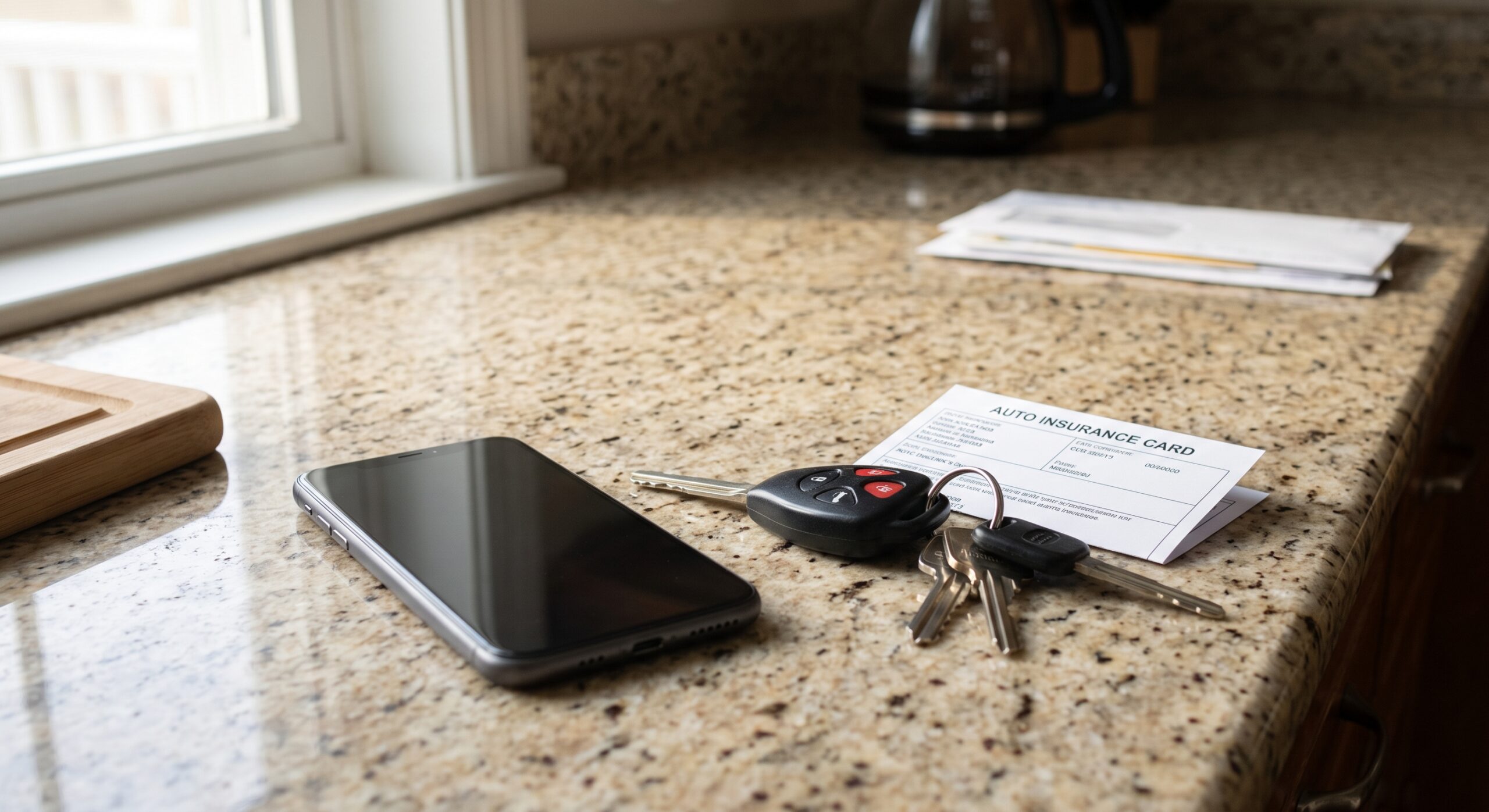
The morning after a rear-end crash on the Eisenhower near Austin Boulevard, the phone rings. The caller is polite, says they represent the other driver’s insurance company, gives a claim number, and then asks one question that changes the tone: “Do you mind if I record this?”
Most people say yes because they think they have to. In Illinois, they don’t. Nothing in Illinois law requires a person to give a recorded statement to the insurance company for the driver who hit them.
The part almost nobody explains is why that answer flips when it’s your own insurance company calling. The difference is not about politeness or fault. It’s about whether you signed a contract with the company asking.
This post is one piece of our full guide to Illinois car accident claims, which walks through the whole process from the scene to a settlement or a filed case.
Two insurers, two completely different relationships
After a two-car crash, two insurance companies usually get involved, and people tend to treat them as interchangeable. They are not.
Your own insurer: you have a contract
Every Illinois auto policy contains a duty-to-cooperate clause. The wording varies by company, but it generally obligates the policyholder to report the crash promptly, provide information about how it happened, help the insurer investigate, and sit for a recorded statement or, in some cases, a formal examination under oath. That duty is part of the bargain you made when you bought the policy.
This matters even when your own insurer is the one paying you. If the other driver had no coverage or not enough of it, an uninsured or underinsured motorist claim goes to your own company — and your own company then becomes the party deciding how much your claim is worth. The cooperation clause still applies. People are sometimes surprised that their own insurer takes a recorded statement and asks pointed questions about speed, phone use, and prior injuries. Under the policy language, it generally can.
The other driver’s insurer: no contract, no duty
You never signed anything with the company that insures the driver who hit you. You are not its customer. There is no Illinois statute, and no provision of the Illinois Insurance Code, that obligates an injured person to sit for a recorded interview with the other side’s adjuster.
That company is investigating a claim against its own policyholder. Its adjuster is not neutral, even when the call is friendly. We’ve written separately about why the first call is warm and the first offer is low.
What Illinois law actually does require
There are real legal duties after a crash. A recorded statement to the other side’s insurer is not one of them. The duties generally include:
- Exchanging information at the scene. Under 625 ILCS 5/11-403, drivers involved in a crash that causes injury, death, or property damage must give their name, address, and vehicle registration number to the other people involved, and show their driver’s license on request.
- Staying and rendering aid. Leaving the scene of a crash involving injury is a criminal offense in Illinois.
- Reporting the crash. Illinois requires a written crash report for collisions above a set damage threshold when law enforcement did not investigate and file one. Most crashes on the Kennedy, on Cicero Avenue, or in a Schaumburg parking lot get a police report, which usually satisfies it. The rules have exceptions, so it’s worth confirming.
- Notifying your own insurer. This one comes from your policy, not a statute, and the notice period is usually described as “prompt.”
Notice what’s missing from that list. There is no duty to explain your injuries to the opposing adjuster, no duty to guess at speeds on tape, and no duty to answer questions two weeks later about a conversation you never agreed to have.
Why the adjuster wants it recorded
Adjusters ask for recorded statements early for practical reasons, and understanding them takes the mystery out of the call.
Fault gets scored in percentages. Illinois uses modified comparative fault under 735 ILCS 5/2-1116. Damages are reduced by the injured person’s share of the fault, and a person found more than 50 percent at fault recovers nothing. So every sentence that sounds like “I might have been going a little fast” or “I didn’t see him until the last second” is not just a memory — it’s a number in a file. A statement taken 18 hours after a crash, before the police report is even available, is the cheapest way to build that number.
Injuries get locked in before the medical picture is clear. Adjusters open with “How are you feeling today?” It sounds like small talk. A person who says “okay, just a little stiff” on day two has created a recording that will be read back months later if a disc herniation or a concussion shows up. Symptoms that surface days later are common, which is why delayed injuries after a car accident are worth knowing about before anyone describes their condition on tape.
Recordings are permanent. The statement gets transcribed. If a case is later filed at the Daley Center or in the Eighteenth Judicial Circuit in Wheaton, that transcript can be used to challenge testimony that differs from it — even where the difference is a normal product of time and better information.
What generally happens if someone declines
This is the fear that pushes people into saying yes. It’s usually overblown.
A claim does not get denied because an injured person declined to be recorded. The other driver’s insurer evaluates the claim from the police report, photographs, repair estimates, medical records, and the statements of its own insured and any witnesses. Those are the materials it relies on most anyway.
What people generally do instead is give the basics in writing or by phone without a recording: names, date, location, vehicles, the claim number, and where the car can be inspected. Property damage claims usually move on that alone. Many people also say they’ll discuss the injury side once treatment is further along, which is not a refusal so much as a timing choice.
If an adjuster suggests the claim cannot proceed without a recording, the Illinois Department of Insurance takes consumer complaints about claim handling. Most of the time it doesn’t come to that.
Your own insurer is where declining has consequences
Here’s the asymmetry worth remembering a week from now. Refusing the other side’s adjuster generally costs nothing. Refusing your own insurer can cost coverage.
Because the cooperation clause is a contract term, an insurer that is genuinely prejudiced by a policyholder’s refusal to cooperate can raise that as a defense to coverage. That comes up most often in uninsured and underinsured motorist claims, where the insurer’s role shifts from your ally to the party writing the check.
This does not mean answering every question without preparation. It means the two calls are not the same call, and treating them the same is where people get into trouble. For crashes involving a rideshare vehicle, the coverage layers add another wrinkle — whose insurance pays after an Uber or Lyft crash in Illinois walks through that.
When this usually does not need a lawyer
Plenty of crashes don’t. A low-speed tap on Dempster Street in Skokie, no injury, a bumper cover and a sensor, the other driver cited and their insurer accepting responsibility — that is a property damage claim. People handle those on their own all the time, without a recorded statement and without hiring anyone. The same is true of a fender-bender where a person is checked out, released, and back to normal within a few days with no bills beyond one visit.
Where people more often talk to a lawyer is when treatment continues past a couple of weeks, when fault is disputed, when the crash involved a commercial truck or a government vehicle, or when an adjuster is pressing hard for a statement and an early release at the same time.
Timing, and one deadline worth knowing
Declining a recorded statement does not pause anything. In Illinois, the general deadline to file a personal injury lawsuit is two years from the date of injury under 735 ILCS 5/13-202, and claims against a city, village, park district, or other local public entity are generally subject to a shorter one-year deadline under 745 ILCS 10/8-101. There are exceptions in both directions, including different rules for minors and for some claims, so anyone with a potential claim should confirm their own date with a lawyer rather than assume.
For the practical side of that first phone call — what to say, what a claim number is for, how to handle a follow-up — see our earlier post on whether to give a recorded statement to the other driver’s insurer.
Talk to us
If you have questions about a crash in Chicago or the suburbs and want to know how the process generally works, call Kass & Moses at 847-513-9582 or use our contact form. Kass & Moses, P.C., 601 Skokie Blvd., Suite 401, Northbrook, Illinois.
Frequently asked questions
A claim is generally evaluated on the police report, photos, repair estimates, medical records, and witness accounts, not on whether an injured person agreed to be recorded. Insurers can and do settle claims where no recorded statement was ever taken. If an adjuster says the claim cannot move at all without one, the Illinois Department of Insurance accepts consumer complaints about claim handling.
A recording cannot be undone, but it is not the last word either. People frequently learn more about their injuries after the fact, and medical records generally carry more weight than an early guess about how someone felt on day two. Anyone worried about something they said on tape can go over it with a lawyer and see how it fits with the rest of the file.
No. A recorded statement is an informal phone interview run by an insurance company during a claim, with no judge, no oath, and no requirement to participate when it is the other side’s insurer asking. A deposition happens after a lawsuit is filed, is taken under oath with a court reporter, and can be compelled through the court. The two are sometimes confused because both produce a transcript.
That is common, since the other driver’s insurer often calls within a day of the crash. Answering questions is not a waiver of anything, and it does not end a claim. People in that situation generally gather the claim number and whatever notes they have about the call and keep them with the rest of their crash paperwork.
Usually yes. Auto policies in Illinois contain a duty-to-cooperate clause, and it generally covers recorded statements and, in some cases, a formal examination under oath. That duty applies even in uninsured and underinsured motorist claims, where your own insurer is the one deciding the value of the claim. Because policy wording differs, the specific obligation depends on the policy.