
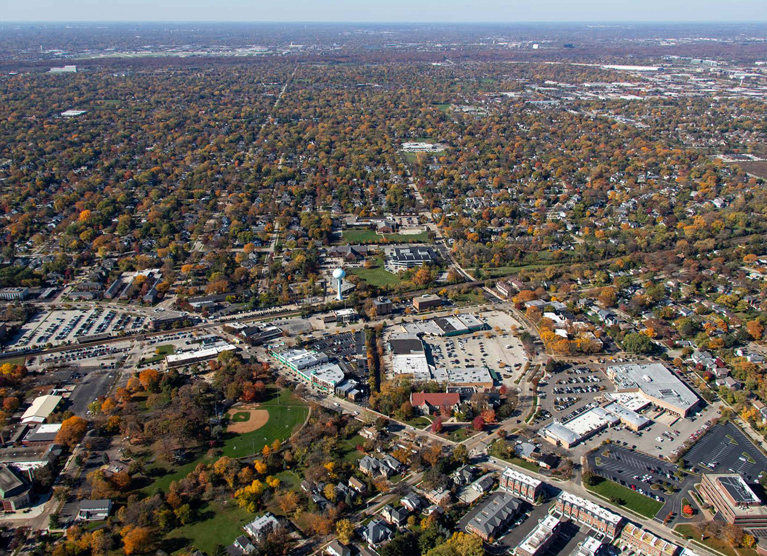
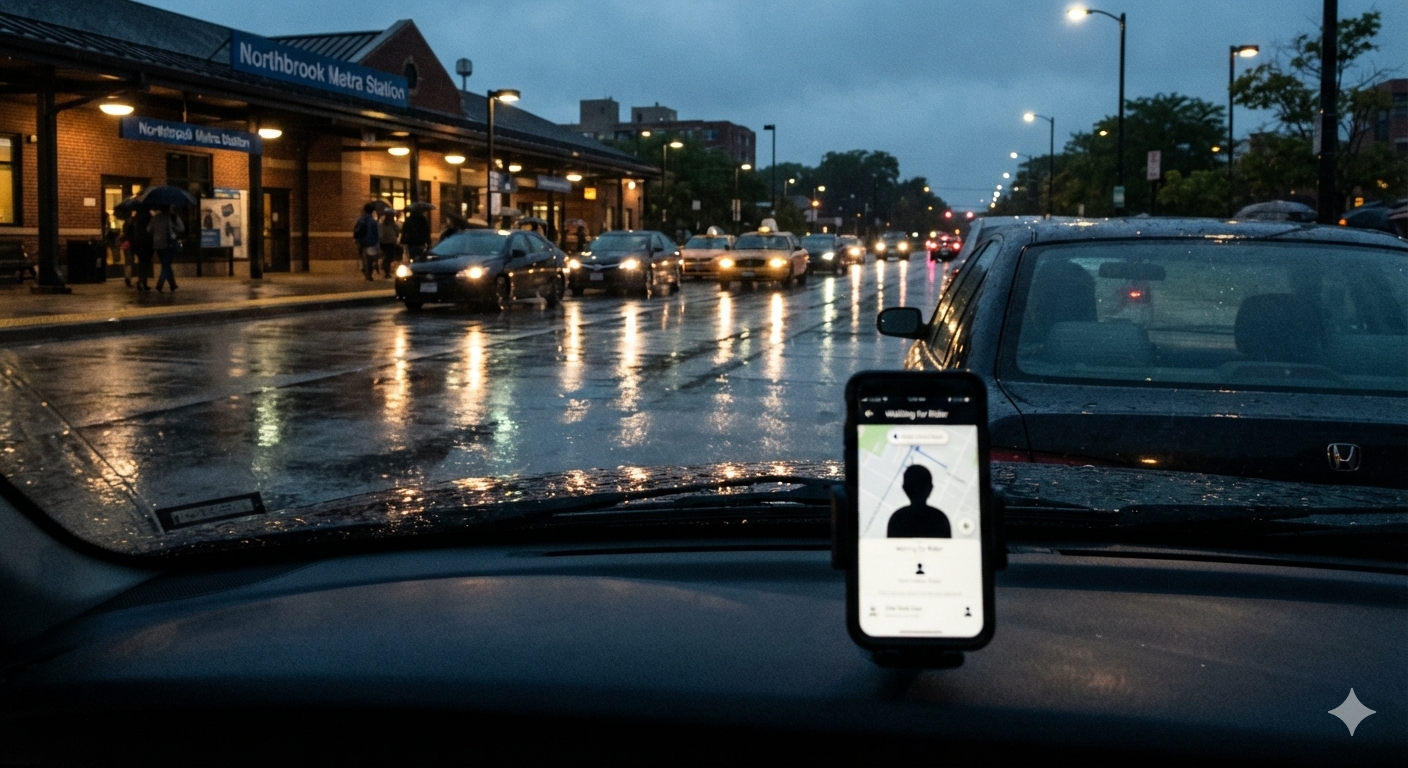
A driver takes a fare from the Northbrook Metra station down Skokie Boulevard, gets rear-ended at Dundee Road, and everybody stands on the shoulder wondering the same thing: who pays for this? The passenger assumes Uber does. The other driver assumes the “Uber’s insurance” covers everything. The rideshare driver has a personal policy that may not cover a minute of it.
In Illinois, the answer turns on two things: who caused the crash, and what the driver’s app was doing at that exact moment.
Fault comes first, not the logo on the windshield
Illinois is an at-fault state. There is no no-fault system for injuries here. The insurance that pays for injuries is the insurance covering the driver who caused the crash. If a driver runs a red light on Willow Road and hits an Uber, the at-fault driver’s policy is the one on the hook, and the Uber coverage may never come into play at all.
Illinois also uses modified comparative fault, 735 ILCS 5/2-1116. Fault can be split by percentage, and a person found more than 50 percent at fault generally recovers nothing. That is why both sides of a rideshare crash often care a great deal about the dashcam, the app data, and the crash report.
The three coverage periods
Illinois regulates Uber, Lyft, and similar companies under the Transportation Network Providers Act, 625 ILCS 57. Section 10 of that Act sets insurance requirements that change depending on the driver’s status in the app. Think of it as three periods.
Period 1: the app is off
The driver is running errands, picking up their kid at Glenbrook North, driving to work. Rideshare coverage does not apply. Only the driver’s personal auto policy does.
Illinois mandatory minimum liability limits are low: generally $25,000 per person and $50,000 per crash for injuries, plus $20,000 for property damage. Many drivers carry only the minimum. That is one reason uninsured and underinsured motorist coverage matters so much in Illinois, and why it is worth knowing what your own policy includes before anything happens.
Period 2: the app is on, but no ride has been accepted
This is the gap period that surprises people. The driver is logged in and circling the lot near Northbrook Court or waiting on Lake Cook Road for a ping. No passenger, no accepted trip.
Under 625 ILCS 57/10, this period generally carries contingent coverage at lower limits than an active trip: commonly stated as at least $50,000 per person, $100,000 per incident for injuries, and $25,000 for property damage. “Contingent” matters. That coverage often sits behind the driver’s personal policy, and many standard personal auto policies exclude driving for hire unless the driver bought a rideshare endorsement. When the personal insurer denies the claim because the driver was logged in, the rideshare policy is generally the one that responds.
Period 3: a ride is accepted, through drop-off
Once the driver accepts a trip, the clock starts. Illinois law generally requires at least $1,000,000 in primary liability coverage for death, bodily injury, and property damage during a prearranged ride, and that coverage runs from acceptance of the request until the passenger is out of the car.
Two things people get wrong here.
First, one million dollars is a limit, not a payment. It is the ceiling on what the policy could pay, not a number anyone receives because a crash happened. What a claim is worth depends on the injuries, the medical records, the fault split, and what a jury in Cook or Lake County would likely do with the facts. Every case is different.
Second, the driver who is on the way to a pickup is already in Period 3. A crash two blocks from the passenger’s house, before anyone gets in the car, is still an active prearranged ride.
What to collect, and why each piece matters
The fight in rideshare claims is often about which period applied. The records below decide it.
- The trip in the app. A screenshot of the receipt or trip detail page is the single most useful thing a passenger can have. It shows the trip ID, the driver’s first name, the vehicle, the pickup and drop-off times, and the route map. That is proof of Period 3. Passengers can also report the crash through the app’s safety or help section, which creates a record with a timestamp.
- The police report number. Northbrook, Glenview, Skokie, and Deerfield police all take crash reports; the Illinois State Police handle the Edens and I-294. Ask the officer at the scene for the report number before anyone leaves. Without it, tracking the report down later means guessing at the date, the agency, and the spelling of names.
- The rideshare driver’s status, in their own words. “I was between rides” versus “I had a passenger” changes the applicable policy. If they say it at the scene, write it down.
- Insurance cards from every vehicle. In a rideshare crash there are usually at least two: the driver’s personal policy and the rideshare company’s certificate.
- Photos before the cars move. Final resting positions, debris, skid marks, the traffic signal, the street signs. Vehicle positions at an intersection like Waukegan and Lake Cook are hard to reconstruct from memory.
- Passenger and witness names and phone numbers. Passengers are independent witnesses to what the driver was doing, including whether they were staring at the app.
- Every crash report requirement. When police do not come to the scene, Illinois drivers are generally required to file a written crash report with the state within 10 days if there is injury, death, or property damage above the statutory threshold. A lawyer can confirm what applies to a given situation.
What usually happens next
Rideshare claims often start with a third-party administrator rather than a name most people recognize. The first call frequently comes within a few days, and the adjuster typically asks for a recorded statement. The reason is practical: a recorded answer given before the medical picture is clear can be quoted back months later. People generally are not required to give a recorded statement to another driver’s insurer, and it is common to talk to a lawyer about that request first. If the tone of that first call feels warm and the first number feels low, there is a reason for both. We wrote about that in why the adjuster is friendly and the first offer is low.
After treatment stabilizes, the usual path is a demand package with medical records and bills, then negotiation, then filing suit if the numbers do not come together. Medical liens can complicate the math: a health insurer or hospital that paid for care may have a right to be repaid out of a settlement, which is why the gross number and the net number are never the same.
When this usually does not need a lawyer
Plenty of rideshare crashes are fender benders. If nobody was hurt, nobody treated, and the dispute is about a bumper, the app’s claims process and the two insurers usually sort it out without anyone hiring counsel. The situations that tend to need a lawyer are the ones with an injury and a disputed period, a denied personal policy, a driver who says the app was off when the passenger’s receipt says otherwise, or a fault argument that could push someone over the 50 percent line.
Deadlines, generally
In Illinois, the general deadline to file an injury lawsuit is two years from the date of the crash, 735 ILCS 5/13-202. Exceptions exist. Claims involving a city, village, park district, or other local public entity, including some public transit vehicles, generally carry a one-year deadline under 745 ILCS 10/8-101, and different rules can apply to minors and wrongful death claims. Anyone with a potential claim should confirm their own date with a lawyer rather than counting on a general rule.
For more on how these claims are handled locally, see our pages on Uber crashes in Northbrook and Lyft crashes in Northbrook, along with our explainer on uninsured motorist claims.
If you have questions about a rideshare crash and want to talk it through with a lawyer, call Kass & Moses at 847-513-9582 or use our contact form. Kass & Moses, P.C., 601 Skokie Blvd., Suite 401, Northbrook, Illinois.