

“I Felt Fine at the Scene”: The Hidden Injuries That Show Up Days After a Car Accident—and Why They Matter to Your Health and Your Claim

One of the most common stories in our line of work goes like this: “I walked away from the crash. I told everyone I was fine. Three days later I could barely turn my head.”
If that sounds familiar, you’re not imagining things, and you’re not being dramatic. Delayed-onset injuries are a well-documented medical reality after car accidents. This article explains why they happen, which symptoms deserve attention, and how the timing of your medical care affects both your recovery and any insurance claim. Consider it a guide from people who’ve seen this pattern thousands of times—shared freely, whatever you decide to do with it.
Why You Felt Fine (When You Weren’t)
During a crash, your body floods with adrenaline and endorphins—a survival response that sharpens focus and, crucially, suppresses pain. It’s why athletes finish games on broken bones and why crash victims decline ambulances, drive home, and collapse into bed feeling merely “shaken up.”
As those chemicals fade over 24 to 72 hours, the real inventory begins. Inflammation from soft-tissue damage builds gradually. Micro-tears stiffen. Bruising deepens. What felt like “a little sore” on Monday became “can’t get out of bed” on Wednesday.
This delay is normal, predictable—and unfortunately, it’s also where many people make decisions (like telling an adjuster “I wasn’t hurt”) that haunt them later.
The Injuries That Commonly Hide
Whiplash and soft-tissue injuries. The rapid back-and-forth motion of a collision strains muscles, ligaments, and tendons in the neck and back. Symptoms—stiffness, reduced range of motion, headaches at the base of the skull—often peak days after the crash. Most cases resolve with treatment; some become chronic, which is impossible to predict in week one.
Concussion and mild traumatic brain injury. You don’t need to hit your head or lose consciousness—the brain can be injured by violent motion alone. Watch for headaches, fogginess, trouble concentrating, irritability, sensitivity to light or noise, sleep changes, and memory hiccups. Family members often notice personality changes before the injured person does. Take these symptoms seriously; early management matters.
Back injuries and disc damage. A herniated or bulging disc may announce itself gradually—first as an ache, then as radiating pain, numbness, or tingling down an arm or leg as inflammation presses on nerves. Days or weeks can pass between crash and full symptoms.
Internal injuries. Rare but serious: deep abdominal pain, dizziness, or deepening bruising in the days after a crash warrant immediate medical attention.
Psychological injuries. Anxiety behind the wheel, intrusive memories of the crash, poor sleep, dread of intersections. Emotional injuries are real, common, treatable—and legitimate components of an injury claim.
The Two-Way Importance of Prompt Medical Care
Seeing a doctor quickly after a crash—and returning when new symptoms emerge—matters in two distinct ways:
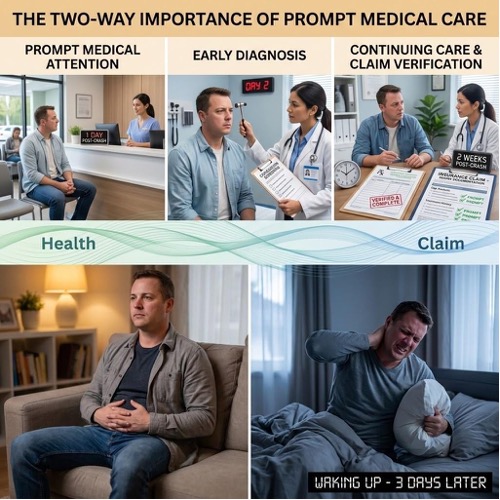
For your health: early diagnosis changes outcomes. Concussions managed early resolve better. Soft-tissue injuries treated promptly are less likely to become chronic. “Toughing it out” is the worst treatment plan ever devised.
For your claim: insurance adjusters scrutinize two things above almost all else—the gap between crash and first treatment, and gaps within treatment. A three-week delay becomes “the injury must have come from something else.” Skipped physical therapy becomes “they couldn’t have been hurting that much.” Neither inference is fair—people delay care because of work, childcare, and cost—but both are used daily to discount claims.
The practical rule: get evaluated promptly, report every symptom to your doctor (even ones that seem minor or embarrassing), and follow the treatment plan. Your medical records become the official story of your injury. Make sure the story is complete.
Why This Is Exactly Why Early Settlements Are Dangerous
Now connect the dots. Insurers often make their first settlement offers within days or a couple of weeks of a crash—inside the very window when hidden injuries are still emerging. That timing is not accidental.
A settlement release is final. Sign it for $7,500 in week two, and when week six brings an MRI showing a herniated disc, there is no renegotiation. The safest general practice is to avoid finalizing any injury settlement until your doctors can say your condition has stabilized and future care needs are reasonably clear—what’s often called maximum medical improvement. (Balance this against your state’s filing deadline; patience and procrastination are different things.)
A Simple Habit That Protects You: The Symptom Journal
Each evening for the weeks after your crash, jot three lines: pain locations and levels, sleep quality, and anything you couldn’t do that day (lifting your toddler, sitting through a work meeting, sleeping through the night).

Months later, this contemporaneous record is worth far more than memory—to your doctors and to your claim.
When to Get a Second Opinion on Your Situation
If your symptoms are resolved in a few days and your losses are minimal, you likely don’t need legal help—handle the property claim and move on with our genuine best wishes.
But if symptoms are lingering, treatment is ongoing, or an adjuster is pressing you to close the claim while you’re still in a doctor’s care, that’s precisely when a free consultation earns its keep. You’ll learn what your claim should account for, what deadlines apply, and whether the offer on the table reflects reality. No obligation follows the conversation—just clarity.
Kass & Moses, PC is at 847-513-9582 whenever you want that second opinion. In the meantime: listen to your body, keep your appointments, and don’t let anyone rush you to the finish line while you’re still finding out what happened to you.
This article is for general information only and is not legal or medical advice. If you’re experiencing symptoms after an accident, see a medical professional. Laws and deadlines vary by state; for guidance on your specific situation, consult a licensed attorney in your area.
We proudly serve clients throughout Northbrook, Lake County, IL, and nearby areas, including Waukegan, Gurnee, North Chicago, Highland Park, Round Lake Beach, Zion, Grayslake, Libertyville, Lake Zurich, Lake Forest, Antioch, Highwood, Mettawa, Mundelein, Vernon Hills, Round Lake, Lindenhurst, and Beach Park.
Kass & Moses Personal Injury Lawyers
601 Skokie Blvd Suite 401
Northbrook, IL 60062
(847) 513-9582