

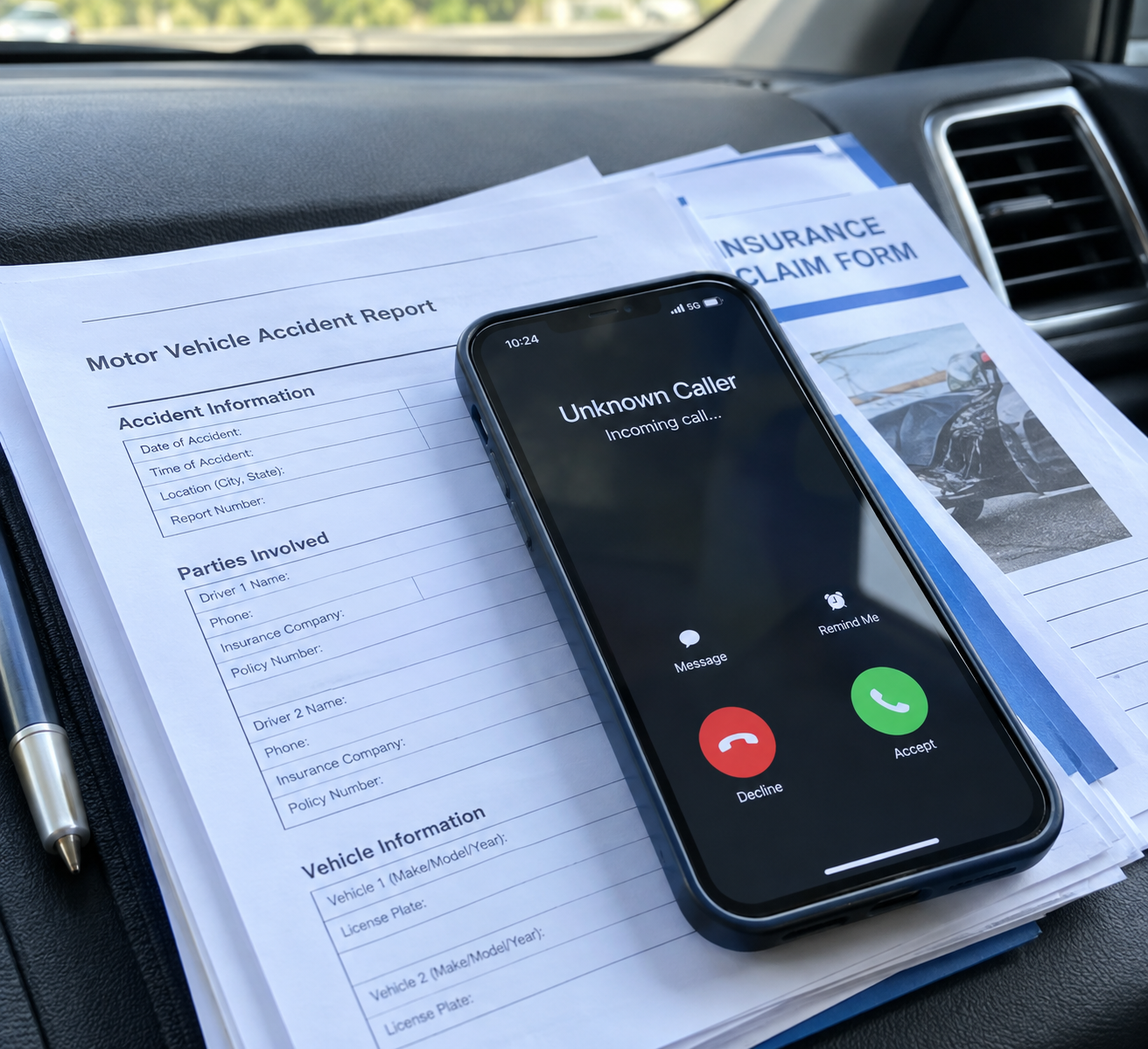
The phone rings a day or two after a crash on Lake Cook Road. The person on the other end is friendly, says they represent the other driver’s insurance company, and asks two things: are you okay, and is it all right if they record this for their file.
Most people say yes, because saying no feels rude and because nobody told them they had a choice.
Here is the general picture in Illinois.
The short answer
In Illinois, a person hurt in a crash generally has no contract with the other driver’s insurance company and generally no obligation to give that company a recorded statement. The duty to cooperate lives in your own insurance policy, not in someone else’s.
That does not make the request sinister. Adjusters take statements because it is their job to investigate a claim before paying it. But a recorded statement is evidence. It gets transcribed, it goes in the claim file, and it can be read back word for word months later if the claim ends up in a lawsuit in the Cook County or Lake County courthouse.
Why the adjuster wants it recorded
Illinois is an at-fault state. There is no no-fault system for bodily injury here. Somebody has to be shown responsible before an insurer pays, and the amount paid is tied to how fault is divided.
That division is governed by 735 ILCS 5/2-1116, Illinois’ modified comparative fault rule. Damages are generally reduced by the injured person’s share of the fault, and if that share is more than 50 percent, the person generally recovers nothing from the other driver. Exceptions and wrinkles exist, which is why fault questions are worth taking seriously rather than answering off the cuff.
So the recorded statement is where fault percentages start taking shape. A guess about how fast the other car was going, a vague “I looked but I didn’t really see them,” an estimate of car lengths on the Edens ramp at Dundee Road — these become the raw material for an argument about shared responsibility.
The questions that show up in almost every recorded statement
The order changes. The substance rarely does.
“How are you feeling today?”
This sounds like small talk. It is a question about injuries, asked at the worst possible time. Soft-tissue injuries and concussions often feel different on day three than on day one, and a cheerful “I’m fine, just sore” recorded on Tuesday can be quoted back after an MRI in October.
“Have you seen a doctor? Which one?”
Adjusters build a treatment timeline, and gaps in treatment are a standard argument for paying less. They also frequently follow up by asking for a signed medical authorization. Broad authorizations can open years of unrelated records, not just the records from the crash.
“Had you ever hurt your back or neck before?”
Prior injuries are a real issue in Illinois cases, but the law generally allows recovery when a crash aggravates an existing condition. A one-word answer in a recorded statement rarely captures that difference.
“How fast were you going? How far away was the other car?”
Most people cannot estimate speed or distance accurately, especially in the second before impact. Recorded guesses tend to harden into facts.
“Were you on your phone? Wearing your seat belt?”
In Illinois, failure to wear a seat belt is generally not admissible to reduce damages in a civil injury case under 625 ILCS 5/12-603.1, but that does not stop the question from being asked and used in negotiation.
“Tell me in your own words what happened.”
The open-ended one. Memory after a crash is patchy, and a detail that turns out to be wrong — the light color, which lane, whether it had started sleeting yet on Skokie Boulevard — can be used to question everything else the person says.
Your own insurance company is a different situation
This is the part people mix up most often.
Almost every Illinois auto policy contains a cooperation clause. If someone makes a claim under their own coverage — medical payments coverage, collision, or an uninsured or underinsured motorist claim — the policy generally requires reasonable cooperation, which can include a statement and sometimes an examination under oath. Refusing outright can put that coverage at risk.
Uninsured motorist coverage matters in the northern suburbs more than people expect. Illinois requires liability coverage of at least $25,000 per person and $50,000 per crash, plus $20,000 for property damage, and requires uninsured motorist coverage at those bodily injury limits. When a driver with minimum limits causes serious harm, the injured person’s own underinsured motorist coverage is often the next place to look — and that claim runs through their own insurer, with its own rules.
The police report detail most people skip
Get the report number before anything else. In Northbrook, Glenview, Deerfield, Highland Park, Skokie, and Evanston, the local police department assigns a case number at the scene, and the Illinois Traffic Crash Report is usually available from that department within a week or two. Illinois State Police handle crashes on the Edens and other state highways.
Two things people get wrong about it. First, the officer’s notation of contributing factors is an opinion, not a ruling; insurers argue about it constantly. Second, when no officer investigates, Illinois law generally requires drivers to file a written crash report with the Illinois Department of Transportation within 10 days if property damage exceeds the statutory threshold. Skipping that step leaves a claim with no official record at all.
When this usually does not need a lawyer
Plenty of crashes do not. A low-speed tap in the Northbrook Court parking lot, nobody hurt, a bumper cover and a sensor to replace — that is a property damage claim. The property damage adjuster will ask about vehicle location, damage, and repair estimates, and giving that information is ordinarily routine. Rental car, shop of your choice, done in a few weeks. Calling a lawyer for that is usually not worth anyone’s time.
The calculation tends to change when someone is treating with a doctor, when fault is genuinely disputed, when a commercial truck or a government vehicle is involved, or when the injuries are the kind that take months to sort out.
What generally happens if someone declines
Usually, not much drama. The adjuster keeps investigating using the crash report, photos, vehicle damage, and any witness information. The claim does not disappear. Some adjusters follow up; some send a letter asking for a written statement instead.
When a lawyer is involved, communication typically shifts to the lawyer’s office, and information goes over in an organized way — records, bills, wage documentation — usually in a written demand after treatment stabilizes. There is no rule that says a statement has to happen on the insurer’s timeline.
The deadlines sitting in the background
Illinois generally gives two years from the date of injury to file a personal injury lawsuit, under 735 ILCS 5/13-202. Exceptions matter. If a claim involves a local public entity or its employee — a village vehicle, a park district truck, a public transit bus — the deadline is generally one year under 745 ILCS 10/8-101, and written notice requirements can apply even sooner. Deadlines for minors and other situations work differently. Anyone with a question about the deadline in their own situation should talk to a lawyer about it rather than rely on a general rule.
Every case is different, and nothing here predicts how any particular claim will turn out.
If you have questions about a crash claim in the northern suburbs, call Kass & Moses or use the contact form on this site, and we can talk through how the process generally works. Kass & Moses, P.C., Northbrook, Illinois.