

Why the Insurance Adjuster Is So Friendly (and Why the First Offer Is So Low): An Honest Look Inside the Claims Process
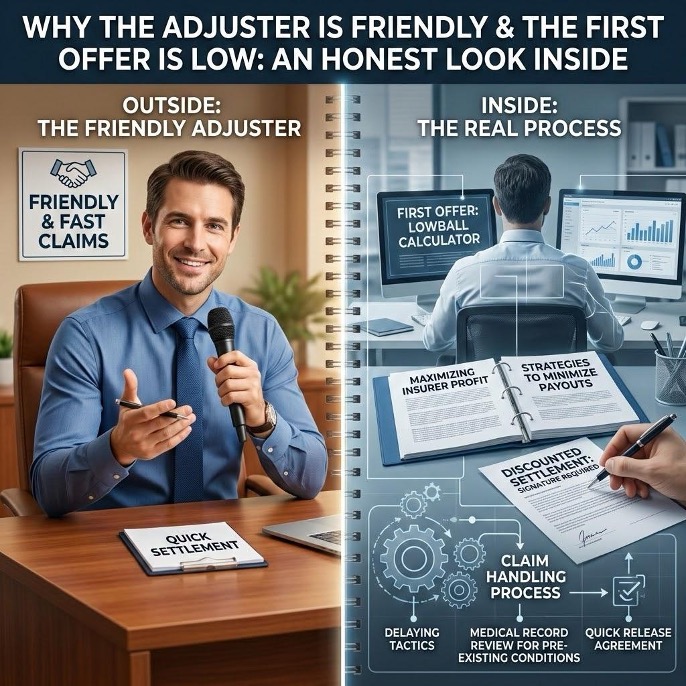
A few days after your car accident, the phone rings. It’s an adjuster from the other driver’s insurance company, and they couldn’t be nicer. They hope you’re feeling better. They just need a quick recorded statement. And good news—they’d like to get you a check right away.
If your instincts tell you something’s off, they’re not wrong. This article explains how the claims process actually works from the inside: why adjusters are trained to be friendly, why first offers are systematically low, and how to protect the value of your claim—whether or not you ever hire a lawyer. We’d rather you understand the game than take our word for anything.
Start With One Clarifying Fact
The adjuster on the phone may be genuinely pleasant, but their professional obligation runs to their employer, not to you. Insurance companies are businesses, and claims are their single biggest expense. Adjusters are evaluated, in part, on how efficiently they close claims—which generally means quickly and for as little as reasonably possible.
None of that makes adjusters villains. It makes them negotiators. And you should engage with them the way you’d engage with any skilled negotiator on the other side of the table: politely, carefully, and without volunteering ammunition.
The Recorded Statement: Understand What It’s For
Early in the process, you’ll likely be asked for a recorded statement, framed as routine—”just to get your side of the story.”
Here’s what’s worth knowing: you’re generally under no obligation to give a recorded statement to the other driver’s insurer. (Your own policy may require cooperation with your own insurer—a different matter.)
Recorded statements serve the insurer in specific ways:
- Locking in your story early, before you’ve seen the police report or fully understood your injuries
- Inviting guesses. “How fast would you say she was going?” Any estimate you offer becomes a fixed fact that can be contradicted later
- Capturing minimizing language. When someone asks “How are you?” most of us say “fine”—reflexively. On a recording, “I’m fine” becomes evidence
- Creating inconsistencies. If your account varies even slightly months later—as all human memory does—the recording becomes a credibility weapon
A courteous decline works: “I’m not comfortable giving a recorded statement. I’m happy to provide the accident report and documentation in writing.”
Why the First Offer Is Low—Structurally, Not Personally
Quick early offers aren’t a compliment to your claim; they’re a pricing strategy. An offer made two weeks post-crash is calculated before anyone knows:
- Whether your injuries fully resolve or become chronic
- What your imaging and specialist visits will reveal
- How much work you’ll ultimately miss
- Whether you’ll need injections, therapy, or surgery down the line
The release you sign to accept that offer is permanent. If a $9,000 settlement is followed three months later by a diagnosis requiring a $40,000 procedure, the difference is yours to absorb. Insurers know that bills and missed paychecks create pressure to take fast money. Patience—waiting until your medical picture stabilizes—is often the single most valuable negotiating asset an injured person has.
The Quiet Tactics Worth Recognizing
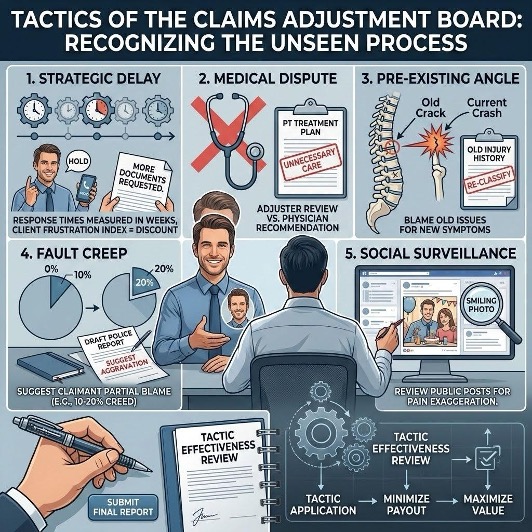
Most claims involve some version of these, so recognize them for what they are:
- Delay. Slow responses and repeated document requests wear people down. Frustration produces discounts.
- Disputing treatment. “That much physical therapy wasn’t necessary.” Adjusters are not your doctors; your physicians determine necessary care.
- The pre-existing condition angle. Prior back or neck issues get blamed for current symptoms. The law in most states protects people whose existing conditions were aggravated by a crash—an aggravation is a compensable injury.
- Comparative fault creep. Suggesting you were partly to blame—even 10 or 20%—directly reduces what they pay in most states. Don’t casually accept fault characterizations you disagree with.
- Social media surveillance. Public posts get reviewed. That smiling photo at your niece’s birthday becomes “evidence” your pain is exaggerated.
How to Strengthen Your Position (With or Without a Lawyer)
- Get consistent medical care and follow through. Gaps and skipped appointments are the #1 claim-killer.
- Document everything: bills, records, missed work, out-of-pocket costs, and a brief daily symptom journal.
- Communicate in writing where possible. Paper trails prevent “misunderstandings.”
- Never sign anything you don’t fully understand—especially medical authorizations giving the insurer access to your entire medical history (they’re typically entitled only to accident-related records).
- Know your deadline. Every state has a statute of limitations. An insurer negotiating slowly loses nothing if your filing deadline quietly passes.
Where Representation Changes the Math
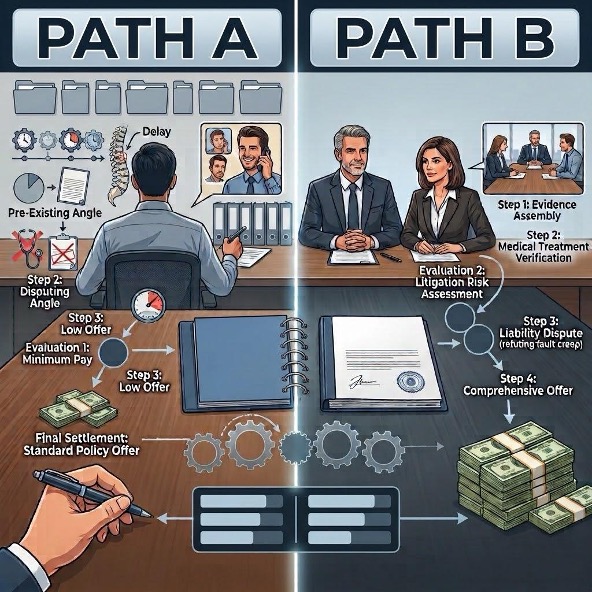
Here’s an honest industry reality: claims handled by counsel are routinely evaluated differently, because the insurer’s alternative to settling is no longer “the claimant gives up”—it’s litigation. That doesn’t mean everyone needs a lawyer. Minor claims with clear fault and quick recoveries often don’t.
But if your injuries are significant, fault is contested, or the offers feel disconnected from your actual losses, a free consultation costs you nothing and tells you a lot: what your claim likely includes, how your state’s rules apply, and whether representation would genuinely add value after fees. If it wouldn’t, a trustworthy attorney will say so.
We’re happy to be that honest sounding board. Kass & Moses, PC is at 847-513-9582—no cost, no obligation, and no pressure. You’ve been through enough to be sold this week.
This article is for general information only and is not legal advice. Laws and deadlines vary by state. For guidance on your specific situation, consult a licensed attorney in your area.
Kass & Moses Personal Injury Lawyers
601 Skokie Blvd Suite 401
Northbrook, IL 60062
(847) 513-9582