

An adjuster calls three days after a crash at Lake Cook Road and Skokie Boulevard and says something like: “Our review shows you were thirty percent responsible, so we’ve adjusted our evaluation.” It lands like a verdict. It isn’t one.
In Illinois, being partly at fault for a crash usually does not end a claim. It changes the math. There is one line where it does end a claim, and that line is written into the statute. Here is where it sits and how the rest of it works.
If you want the whole process in order, from the first phone call to filing suit, start with our full guide to Illinois car accident claims. This post answers one narrower question: what partial fault actually does.
The short answer
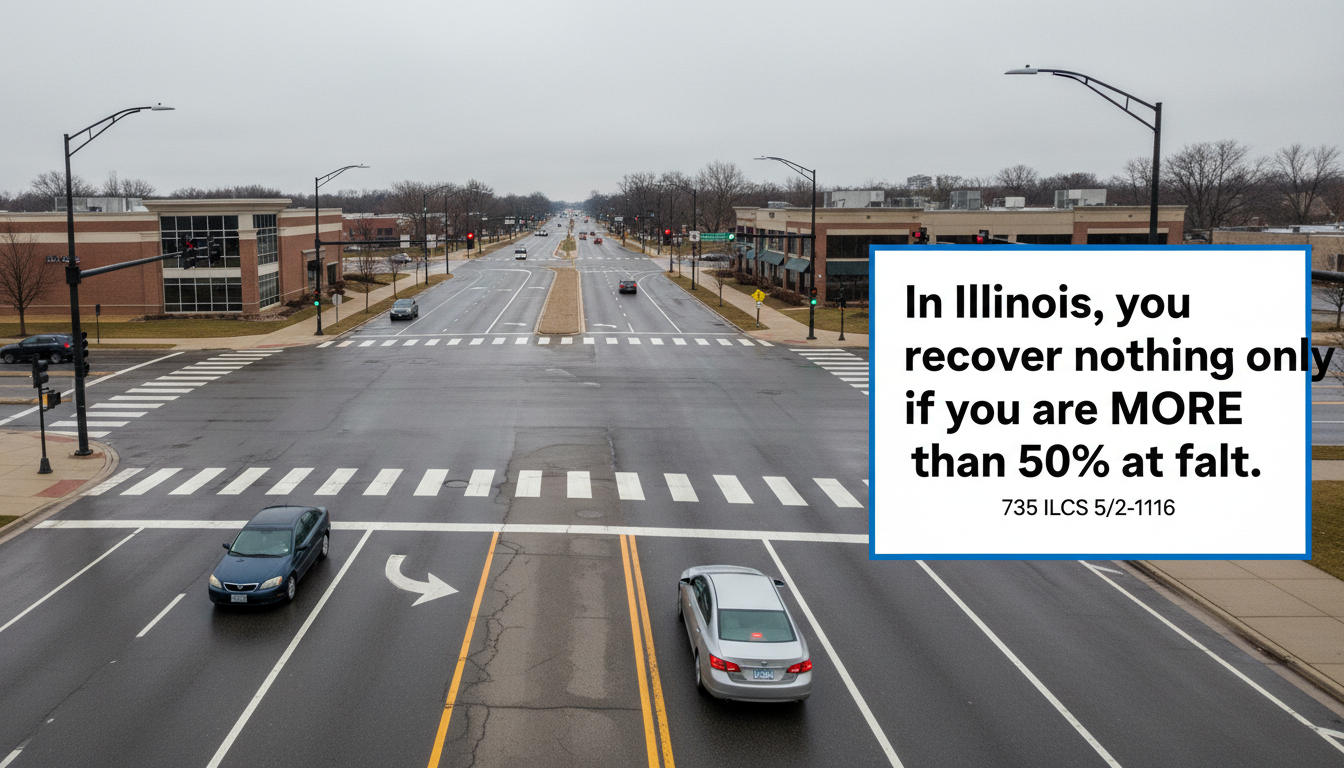
Illinois follows what lawyers call modified comparative fault. A person who is partly to blame for their own injuries can still recover, but the recovery is reduced by their share of the fault. If that share is more than 50 percent, the claim is barred.
So 20 percent at fault is a reduction. 50 percent at fault is a big reduction. 51 percent is the end of the claim.
What 735 ILCS 5/2-1116 actually says
The rule lives in 735 ILCS 5/2-1116. In a negligence or product liability case seeking damages for injury or death, a plaintiff is barred from recovering if their contributory fault is more than 50 percent of the proximate cause of the injury. If the fault is 50 percent or less, damages are reduced in proportion to that percentage.
Two details people miss.
First, it is “more than 50 percent,” not “50 percent or more.” A plaintiff found exactly half responsible still recovers half. That single word does a lot of work in Illinois trials.
Second, the comparison is against the fault of everyone else in the case, not against the other driver alone. In a chain-reaction crash on the inbound Kennedy where three drivers contributed, one person’s share is measured against the total, which can put a plaintiff’s percentage lower than it first looks.
How the reduction works, in plain arithmetic
Suppose a jury decides total damages are $100,000 and finds the plaintiff 25 percent at fault. The judge reduces the award to $75,000. At 40 percent, it’s $60,000. At 51 percent, it’s nothing.
Those numbers are only there to show the arithmetic. They are not a prediction, an average, or a suggestion of what any case is worth. Every case is different, and no one can tell you what a jury will do.
The practical point is that a fault percentage is not a switch. It is a dial. And in settlement talks, the dial is exactly what the two sides are arguing about, even when nobody uses the word “percentage.”
Who actually decides the percentage
This is the part that surprises people most.
In a lawsuit, a jury decides
If a case is tried, the jury gets a verdict form that asks two separate things: the total amount of damages, and the percentage of fault attributable to the plaintiff. The judge then does the subtraction. Jurors in the Daley Center or the Lake County courthouse in Waukegan write a number on a line. That is the only fault percentage with legal force.
In a claim, nobody decides. An adjuster asserts
Before a lawsuit, there is no judge, no jury, and no referee. When an adjuster says “we’re assigning you thirty percent,” that is a negotiating position based on their own file review. It is not a finding. It can be disputed, supported with evidence, or rejected.
Adjusters also know that most claims never reach a courtroom, so a fault percentage floated early often sets the ceiling for everything that follows. That is the same logic behind a fast, friendly first call, which we cover in why the adjuster is friendly and the first offer is low.
The everyday facts used to push fault onto a driver
None of these are exotic. They come up in ordinary Cook, Lake, and DuPage County crashes every week.
- Speed, even a little. “Both drivers were exceeding the posted limit on Ogden Avenue” is an argument for shared fault, whether or not speed caused anything.
- Following distance. In rear-end cases, the trailing driver usually starts with the harder position, but insurers argue the lead driver stopped short, had a burned-out brake light, or cut in. Brake-checking is its own fight; we wrote about that separately in car accidents caused by brake checking in Illinois.
- Left turns. A driver turning left across traffic on Milwaukee Avenue is often assigned a share even when the oncoming car ran the light.
- “You could have avoided it.” The last-clear-chance argument dressed in plain clothes: you saw them coming, you had room, you didn’t brake.
- Delayed medical care. Not a fault argument, technically. It gets used as one anyway, to suggest the injuries came from somewhere else.
- Where a pedestrian crossed. Illinois requires drivers to stop for a pedestrian in a crosswalk, 625 ILCS 5/11-1002, but insurers push hard on crossings outside one, especially on wide suburban roads like Golf Road or Route 83 where the nearest signal is a quarter mile away.
- Phone records. If a phone was in use at the moment of impact, expect it to come up.
The seat belt argument, which is mostly a myth
Insurers sometimes suggest that not wearing a seat belt cuts a claim. Illinois law generally goes the other way: failure to wear a seat belt is not treated as evidence of negligence in a civil case and generally does not reduce damages from a motor vehicle claim, under 625 ILCS 5/12-603.1. There are arguments about how far that reaches in particular cases, so it is worth asking a lawyer rather than assuming the adjuster’s version.
A related myth: that the police report settles fault. It does not. In Illinois civil cases, the officer’s crash report is generally not admissible as evidence at trial, and the officer’s contributing-cause codes are one person’s quick read of a scene they arrived at afterward. Reports still matter enormously early on, because adjusters read them first, but a report that lists you as Unit 1 with a contributing cause is not a finding of law.
A ticket is not the last word either, though how a traffic case is resolved can matter in the civil claim. That is a question worth raising with a lawyer before any plea, because the answer varies with the disposition.
What tends to move a fault percentage back
Evidence, collected early, while it still exists.
- Photographs of position, not just damage. Skid marks, debris field, sightlines, a hedge blocking a stop sign on a side street in Glenview. Damage photos show impact. Scene photos show sequence.
- Video. Gas stations, Metra platforms, warehouse loading docks, and Ring cameras on residential corners all record. Much of it is overwritten in days or a few weeks. Written preservation requests go out fast for a reason.
- Independent witnesses. A name and a cell number from the driver who stopped is worth more than a paragraph of argument later.
- Vehicle data. Most modern cars store a few seconds of pre-crash data, including speed and braking. That data disappears when the vehicle is repaired or salvaged, which is why a total-loss car sometimes gets inspected before it goes.
- The crash report number. Ask the responding officer for it at the scene. It is how the report gets pulled from the Chicago Police Department or a suburban department later.
When this usually does not need a lawyer
If the collision was minor, nobody was hurt, and the only dispute is a fault percentage on property damage, this often resolves without a lawyer. Insurers arbitrate property damage between themselves, and a driver who disagrees with a liability decision can appeal it inside the insurer’s process or through the Illinois Department of Insurance. Small fault disputes over a bumper are not usually worth a contingency fee to anyone. Our post on whether to hire a lawyer after a minor car accident goes through where that line tends to fall.
Where people more often get help is when an injury is involved and a percentage is being used to discount it, or when several vehicles and several insurers are pointing at each other.
Deadlines keep running while fault is argued
A fault dispute does not pause the clock. In Illinois, the general deadline to file a personal injury lawsuit is two years from the date of injury, 735 ILCS 5/13-202, with exceptions that can shorten or extend it depending on who is involved and who was hurt.
Some of those exceptions are much shorter. Claims against a city, village, park district, or other local public entity generally must be filed within one year, 745 ILCS 10/8-101. For injuries on a CTA bus or train, written notice generally goes to the CTA within six months and suit within one year, 70 ILCS 3605/41. Anyone dealing with a specific date should confirm it with a lawyer rather than counting on a general rule.
The line worth remembering
Partial fault in Illinois is a discount, not a door slammed shut, until it crosses 51 percent. And the number an adjuster puts in a letter is an opening position, not a ruling.
If you have a question about how fault is being handled in an Illinois crash claim, you can call Kass & Moses at 847-513-9582 or use our contact form. Talking it through costs nothing, and we will tell you when a situation does not call for a lawyer.
Kass & Moses, P.C., 601 Skokie Blvd., Suite 401, Northbrook, Illinois. This post is general information about Illinois law, not legal advice about any particular situation. Every case is different.
Frequently asked questions
Generally yes. Under 735 ILCS 5/2-1116, the bar applies only when a plaintiff’s fault is more than 50 percent of the proximate cause. At exactly 50 percent, damages are generally reduced by half rather than eliminated. Whether a case lands at 50, 45, or 55 depends entirely on the facts and who is deciding.
No. A traffic citation is a separate case from the injury claim, and an officer’s opinion at the scene is not a legal finding of fault. How the ticket is ultimately resolved can matter in the civil claim, though, in ways that vary with the disposition. That is worth asking a lawyer about before any plea is entered.
An adjuster can state a percentage in a letter or on the phone, and many do. It is a negotiating position from the company paying the claim, not a ruling by anyone neutral. In a lawsuit, the percentage is decided by the jury on the verdict form, and the judge applies the reduction.
Generally not. A passenger who did nothing wrong usually has no fault of their own to subtract, and may have claims against more than one driver, including the driver they were riding with. How that plays out depends on the coverage available and who is found responsible, so it is worth discussing with a lawyer.
The comparative fault rule generally applies the same way, but the deadlines are much shorter. Claims against a local public entity generally must be filed within one year under 745 ILCS 10/8-101, and CTA injuries generally require written notice within six months and suit within one year under 70 ILCS 3605/41. Anyone in that situation should confirm the exact date with a lawyer.