
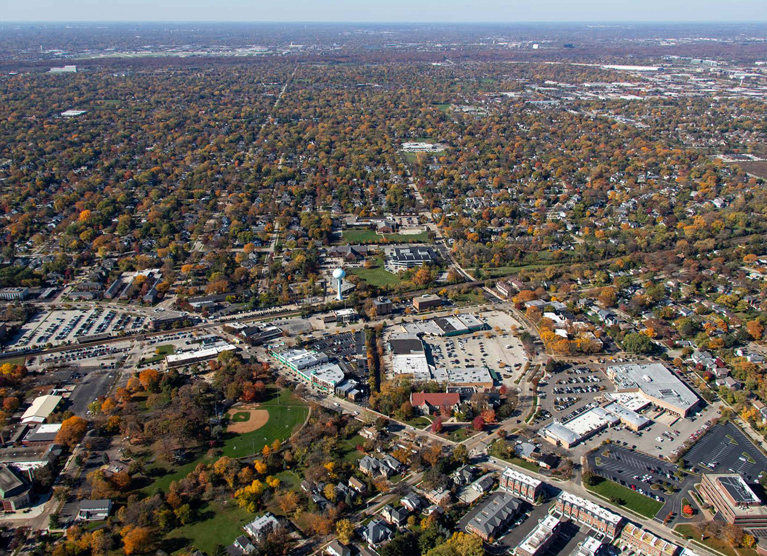
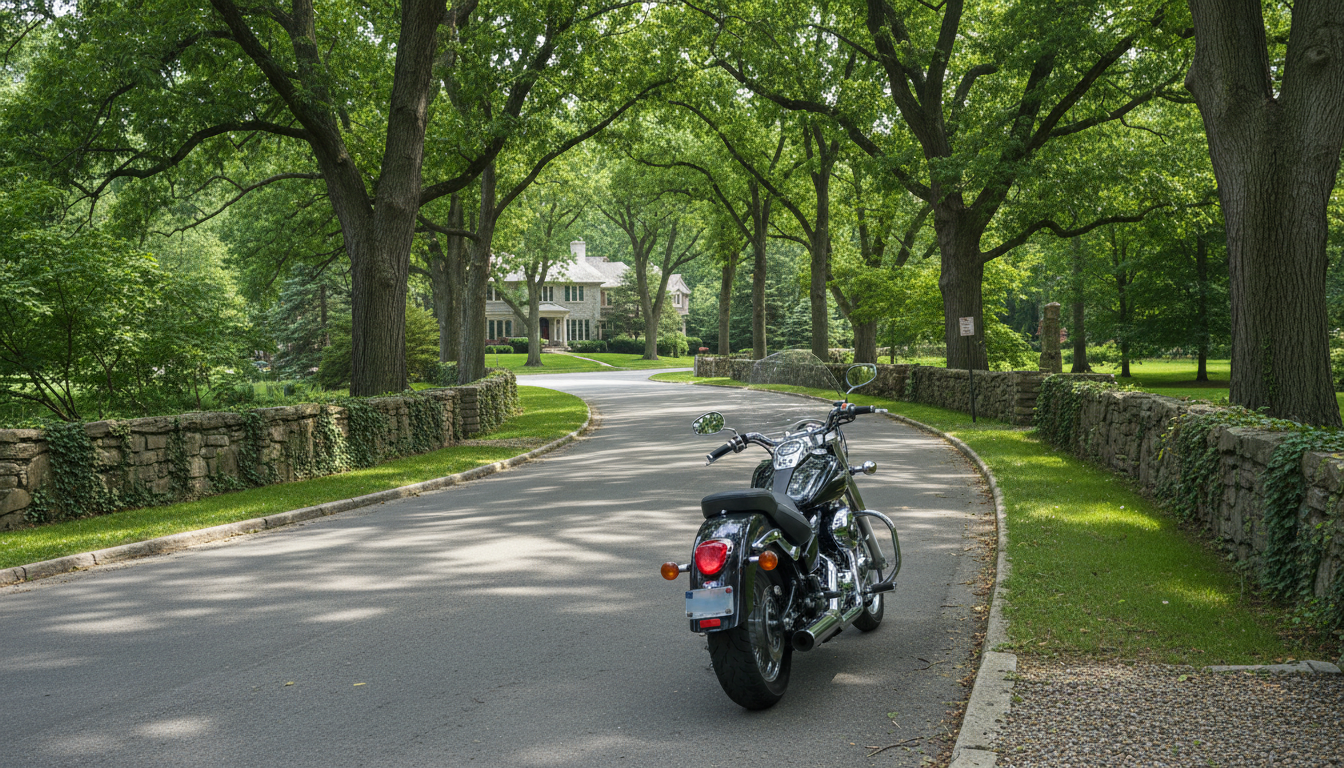
A rider is heading north on Skokie Boulevard on a clear Saturday in May. A driver waiting to turn left into a shopping center looks straight at the bike, then turns. The driver says the same sentence almost every time: “I never saw the motorcycle.”
That one crash pattern accounts for a large share of the motorcycle cases that come out of Northbrook, Glenview, Deerfield and the rest of the North Shore between April and October. Here is how these wrecks usually happen, what Illinois law says, and what tends to happen in the weeks after.
The left-turn crash is the one we see most
NHTSA crash data has consistently shown that in roughly four out of ten fatal two-vehicle crashes involving a motorcycle, the other vehicle was turning left while the motorcycle was going straight or passing. Nothing about the North Shore changes that math. If anything, the road design here feeds it.
Think about the left-turn setups people ride through every weekend: Lake Cook Road at Waukegan, Willow Road at the Edens ramps, Dundee Road through Northbrook and Wheeling, Skokie Boulevard’s long stretches of strip-mall entrances. Wide lanes, heavy turning traffic, and drivers looking for a gap rather than looking for a motorcycle.
Two things make a bike easy to miss. It presents a narrow front profile, so a driver scanning for a car-sized shape can look right through it. And most people are bad at judging how fast a small object is closing. A driver who would never pull out in front of a Suburban will pull out in front of a bike traveling the same speed.
What the law says about who yields
Illinois puts the duty on the turning driver. Under 625 ILCS 5/11-902, a driver turning left within an intersection or into a driveway has to yield to a vehicle approaching from the opposite direction that is close enough to be an immediate hazard. A motorcycle is a vehicle. “I didn’t see it” is not a defense to that rule.
That does not mean fault is automatic. Insurers routinely argue the rider was speeding, was passing in a way the driver could not anticipate, or hit the brakes late. Illinois uses modified comparative fault under 735 ILCS 5/2-1116: a person’s recovery is reduced by their share of the fault, and if their share is more than 50 percent, they generally recover nothing. So the fight in a left-turn case is often not whether the driver was at fault but how much of the blame gets pushed onto the rider.
This is why the physical evidence matters more in motorcycle cases than in fender benders. Skid marks, the final rest position of the bike, damage to the car’s front quarter panel, and the timing on a nearby traffic signal can all speak to speed and to who had the right of way.
Sheridan Road is its own kind of hazard
Sheridan Road through Wilmette, Kenilworth, Winnetka, Glencoe and Highland Park is a favorite ride and a difficult one. The speed limits drop into the 25 to 30 range for good reason. The road bends, the sight lines close up behind mature trees and stone walls, and there are hidden driveways every few hundred feet.
The crashes we see on that corridor tend to look different from the Lake Cook Road left-turn wreck:
- Driveway pull-outs. A driver backing or nosing out of a wooded drive who cannot see far enough up the road.
- Car doors. Illinois makes it unlawful to open a door into moving traffic when it is not reasonably safe, under 625 ILCS 5/11-1407. On a stretch with curbside parking, an opening door gives a rider almost no room to react.
- Surface debris in the curves. Sand and gravel left over from winter, wet leaves in the fall, and construction runoff all sit in the outside line of a curve, which is exactly where a bike wants to be.
When the road itself is the problem
Sometimes the hazard is a pothole, a broken pavement edge, or a utility cut that was never patched level. Claims like that run against whichever public body maintains the road, and the deadline is much shorter. Under 745 ILCS 10/8-101, claims against a city, village, park district, county or other local public entity generally must be filed within one year, not two, and there are notice issues on top of that. Lake Cook Road alone is split between jurisdictions along its length. Sorting out which entity is responsible takes time that a one-year clock does not leave much of. Exceptions exist, and these deadlines are worth asking a lawyer about early.
Helmet facts riders and drivers both get wrong
Illinois does not require adult riders to wear a helmet. The Insurance Institute for Highway Safety lists Illinois as one of only three states with no motorcycle helmet requirement at all. That surprises people, including some adjusters from out of state.
Eye protection is required. Under 625 ILCS 5/11-1404, a person operating a motorcycle generally must wear glasses, goggles or a transparent face shield unless the bike has a windscreen. Riders who get cited after a crash are more often cited for this than for anything helmet-related.
Not wearing a helmet is not automatically “comparative fault.” Because Illinois imposes no helmet duty on adult riders, insurers generally cannot turn helmet nonuse into a negligence argument the way they might with a genuine traffic violation. That said, how helmet evidence is handled can vary with the facts and the injuries claimed, so it is a question for a lawyer rather than a rule to bank on.
Helmets still matter to the physics. NHTSA has estimated helmets to be about 37 percent effective at preventing death for riders and about 69 percent effective at preventing head injuries. Legal and sensible are two different questions.
Lane splitting is illegal here. Riding between lanes of traffic is prohibited in Illinois under 625 ILCS 5/11-703(d). On a backed-up Edens in July, this comes up often, and it hands the other side a comparative fault argument.
What usually happens after a crash, in order
- Medical care and the crash report. Illinois police departments complete a Traffic Crash Report. Ask the responding agency for the report number before leaving the scene if that is possible. The number is what everyone else uses to find the file.
- The bike becomes evidence. Tow yards charge storage daily and eventually dispose of vehicles. People often authorize a total-loss payout and release the bike before anyone photographs the damage. Once it is gone, the speed and impact-angle questions get much harder to answer.
- The adjuster’s first call. It usually comes within a few days, and it usually includes a request for a recorded statement. Adjusters want a description of speed, lane position and injuries locked in early, before anyone knows what the injuries actually are. Nothing in Illinois law requires giving a recorded statement to the other driver’s insurer.
- Treatment, then a demand. Most claims are not presented until treatment stabilizes, because the full picture is not known before then. That can take months.
- Negotiation, and filing if it stalls. The general deadline for an Illinois injury lawsuit is two years under 735 ILCS 5/13-202, with real exceptions, including the shorter public-entity deadline above and different rules for minors. Every case is different, and the deadline that applies to any particular claim is worth confirming with a lawyer.
One mechanic nobody explains: health insurers and some medical providers can assert a lien, which is a legal claim to be repaid out of any settlement. It affects what a resolution actually looks like, and it is a normal part of these cases.
When a rider usually does not need a lawyer
If a bike got scratched in a parking lot, nobody was hurt, and the other driver’s insurer accepts fault, that is a property damage claim. People handle those directly all the time. The same is often true of a low-speed tip-over with no injury and no dispute about who was at fault. Where a lawyer tends to matter is when there is an injury with ongoing treatment, when fault is contested, when the other driver was uninsured or fled, or when a public body may share responsibility for the road.
If you have general questions about a motorcycle crash in the northern suburbs, you can call our office or use the contact form on this site. We are glad to explain how the process generally works, even if you are only gathering information.
Kass & Moses, P.C. — Northbrook, Illinois.