


A car accident compresses a hundred decisions into the worst possible moment to make them.
Tow trucks, insurance calls, rental cars, doctor visits, missed work—all while you’re sore, shaken, and just trying to get life back to normal.
This guide lays out what actually matters in the first two weeks after a crash, in order. It’s the same advice we give family members. No scare tactics, no hard sell—just the roadmap. Bookmark it, share it, use what helps.
Days 1–2: Health and Documentation
See a doctor, even if you “feel okay.” The most common car crash injuries—whiplash, soft-tissue damage, concussions—often don’t fully surface for 24 to 72 hours. Adrenaline masks pain, and the true stiffness or headaches arrive later. Getting checked promptly protects your health and creates a medical record connecting your symptoms to the crash. Insurance adjusters treat gaps in treatment as evidence you weren’t really hurt. Secure the basics while they’re fresh:
- Photos of all vehicles, the scene, road conditions, and any visible injuries
- The police report number (request the full report when available)
- The other driver’s insurance, license, and plate information
- Names and numbers of any witnesses
Report the crash to your own insurance company. Most policies require prompt notice, and
failing to report can jeopardize your own coverage. Reporting is not the same as filing a claim
against yourself—it’s a policy obligation.
Days 2–7: Handle the Insurance Calls Carefully

Expect a call from the other driver’s insurance company, often within days. The adjuster will be pleasant. They may ask for a recorded statement and might mention a quick settlement to “wrap this up for you.”
Three things worth knowing:
- You generally have no obligation to give a recorded statement to the other driver’s insurer. Adjusters are trained to ask questions that create ammunition—getting you to guess at speeds, minimize the crash, or say you’re “feeling better.” You can decline politely: “I’m not prepared to give a recorded statement. I’ll follow up in writing.”
- Never guess. If you don’t know how fast the other car was going, “I don’t know” is the correct answer. Guesses become sworn facts later.
- Early offers are early for a reason. An offer made ten days after a crash is priced before anyone—including you—knows whether that neck pain resolves in two weeks or requires injections in six months. Once you sign a release, the claim is closed forever, no matter what your MRI shows later.
Days 3–14: Build Your Paper Trail
The difference between claims that resolve fairly and claims that don’t usually comes down to documentation. Start a simple folder (physical or digital) containing:
- All medical records and bills—ER, urgent care, primary care, imaging, physical therapy, prescriptions
- Proof of missed work—pay stubs, a letter from your employer, records of used PTO
- Out-of-pocket expenses—rental car, rideshares to appointments, medications, medical equipment
- A daily symptom journal. Two minutes a night: pain levels, sleep quality, activities you couldn’t do. Months from now, when an adjuster asks how the injury affected your life, you’ll have answers instead of vague memories.
- Also: stay off social media regarding the crash and your activities. A single gym check-in or vacation photo can be twisted into “proof” you weren’t hurt. Adjusters look. Assume everything you post will be read by someone whose job is minimizing your claim.
Understanding What Your Claim Includes
Many people assume a claim covers the ER bill and the repair estimate. A complete claim, when someone else caused the crash, typically includes:
- All accident-related medical care, past and future
- Lost wages and any lasting impact on earning ability
- Vehicle damage or fair market value if totaled (plus, in some states, “diminished value” of a repaired car)
- Out-of-pocket costs
- Pain, suffering, and disruption to your daily life
You don’t need to total this up today. Just avoid closing the claim before the picture is complete.
Deadlines You Should Know Exist
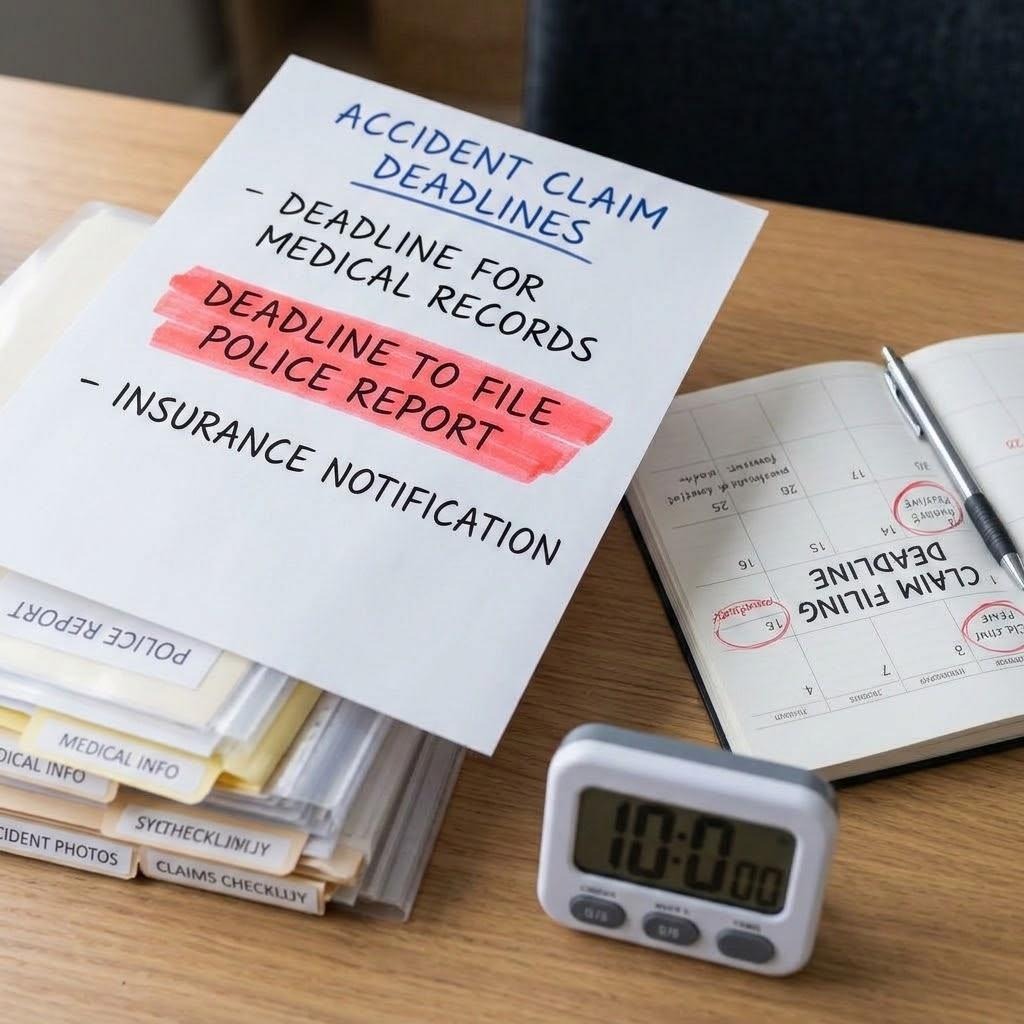
Every state has a statute of limitations—a deadline for filing a lawsuit, commonly between one and several years, depending on the state and the type of claim. Claims against government entities (say, a city vehicle) often carry much shorter notice deadlines, sometimes just months.
You don’t need to memorize the rules; you just need to know deadlines exist so “I’ll deal with it later” never quietly becomes “too late.”
Do You Need a Lawyer?
Honest answer: not always. Fender-benders with no injuries are usually manageable on your own. But a conversation with an attorney tends to be worth your time when:
- You needed ongoing medical treatment
- Fault is disputed or the police report seems wrong
- The offer feels low, or the adjuster keeps stalling
- The crash involved a commercial vehicle, a government vehicle, or an uninsured driver
- Your injuries are affecting your work or family life
Consultations at reputable injury firms are free, and contingency arrangements mean no fees unless you recover. There’s no obligation attached to a phone call—the worst outcome is that you understand your situation better than you did before. In our experience, people who are given real information make the right decision for themselves. That’s the whole philosophy.
If we can help you make sense of your situation, Kass & Moses, PC is at 847-513-9582 . And if you just needed this checklist—that’s a win too. Take care of yourself.
This article is for general information only and is not legal advice. Laws and deadlines vary by
state. For guidance on your specific situation, consult a licensed attorney in your area.
We proudly serve clients throughout Northbrook, Lake County, IL, and nearby areas, including Waukegan, Gurnee, North Chicago, Highland Park, Round Lake Beach, Zion, Grayslake, Libertyville, Lake Zurich, Lake Forest, Antioch, Highwood, Mettawa, Mundelein, Vernon Hills, Round Lake, Lindenhurst, and Beach Park.
Kass & Moses Personal Injury Lawyers
601 Skokie Blvd Suite 401
Northbrook, IL 60062
(847) 513-9582