

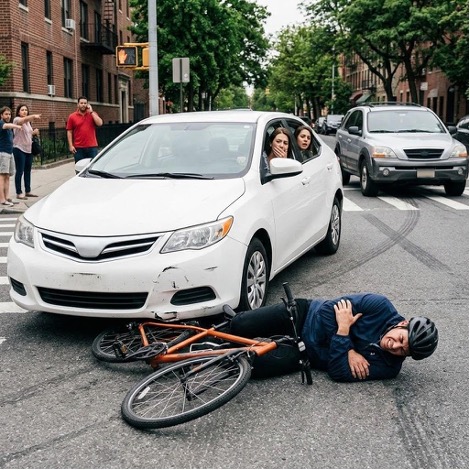
Being struck by a car while cycling is uniquely jarring. One moment you’re on your commute or weekend ride; the next you’re on the pavement, checking whether your body and your bike are in one piece, while a driver stands over you asking if you’re okay.
If that’s you—recently or right now—this guide is meant to bring some order to the chaos. It’s the advice we’d give a friend: practical, honest, and free of pressure. Read what’s useful and leave the rest.
Step 1: Treat Every Impact as a Medical Event
Cyclists have no protection beyond a helmet and clothing. Even a “minor” collision transfers serious force through your body. And here’s the tricky part: adrenaline is remarkably good at hiding injuries. Riders regularly get up, say “I’m fine,” ride home—and wake up the next day unable to move their neck, or discover a fracture a week later.
See a doctor promptly, even if you feel okay. Concussions, internal injuries, and fractures don’t always hurt right away. Beyond your health, prompt medical care creates a record connecting your injuries to the crash—something that becomes very important if you later file a claim. A gap in treatment is the first thing an insurance adjuster will use against you.
Step 2: Resist the Urge to Say “I’m Fine”
It’s human nature. You’re embarrassed, shaken, and the driver seems apologetic. Many cyclists reflexively minimize: “I’m okay, really, don’t worry about it.”
Those words can follow you. If injuries surface later, the driver’s insurance company may quote you: “He said at the scene he was fine.”
You don’t need to be hostile—just accurate. “I’m shaken up and I’ll need to get checked out” is honest and protects you.
Step 3: Call the Police, Even for a “Minor” Crash
Some drivers will suggest handling things informally—”no need to involve the police, here’s my number.” We understand the impulse, but a police report matters:
- It creates an official record of when, where, and how the crash happened
- It documents the driver’s identity and insurance (phone numbers can stop being answered)
- Officers may note statements the driver made at the scene—admissions like “I just didn’t see you” often evaporate later
If police won’t respond to a non-injury crash in your area, you can typically file a report yourself. Do it while details are fresh.
Step 4: Document Like Your Claim Depends on It (It Might)
If you’re able—or a bystander can help—capture:
- Photos: your bike, the car (including license plate), the road, the bike lane or shoulder, traffic signs, skid marks, and your injuries
- The driver’s info: license, insurance card, plate number, phone
- Witnesses: names and numbers. Independent witnesses are enormously valuable and nearly impossible to track down later
- Nearby cameras: note any businesses, intersections, or homes with cameras facing the scene. Footage is often overwritten within days, so it needs to be requested quickly
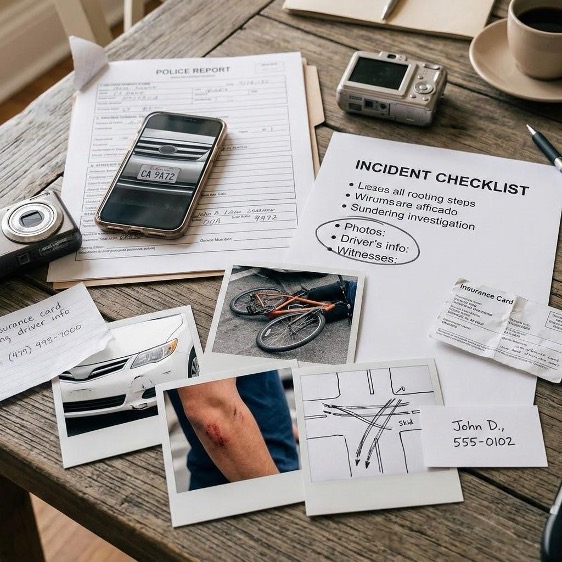
And critically: keep your bike and gear exactly as they are. Don’t repair the bike, don’t toss the cracked helmet, don’t wash the torn clothing. They are physical evidence of the impact’s force and direction. Photograph everything, then store it.
Step 5: Understand Whose Insurance Pays (It May Surprise You)
Many cyclists assume that because they were on a bike, car insurance doesn’t apply to them. Usually, the opposite is true:
- The driver’s liability insurance is the primary source of compensation when the driver is at fault—covering your medical bills, lost wages, bike, and pain and suffering.
- Your own auto policy (if you have one) may cover you even though you were on a bicycle. Uninsured/underinsured motorist coverage often applies to you as a cyclist or pedestrian—a fact many people never learn. This matters enormously in hit-and-run cases.
- Health insurance covers treatment in the meantime, though it may seek reimbursement from any settlement.
The point: don’t assume there’s no coverage. There are usually more options than crash victims realize.
Step 6: Be Wary of the Quick, Friendly Settlement
If the driver was clearly at fault, their insurer may call quickly with a modest offer and a release form. It can feel like a relief—until you realize the number didn’t account for the physical therapy you’d need, the weeks of missed work, or the fact that your $4,000 bike was reimbursed at $800.
Two rules of thumb:
- Don’t give a recorded statement to the other side’s insurer without advice.
- Don’t sign a release until you know the full extent of your injuries and losses. A release is final.
When Talking to a Lawyer Makes Sense
If the crash left you with scrapes and a bent wheel, you can likely handle it yourself. But consider at least a free consultation if:
- You needed medical treatment beyond a single checkup
- The driver disputes fault or claims you “came out of nowhere”
- It was a hit-and-run
- The insurer is delaying, lowballing, or asking for a recorded statement
- Your injuries are affecting work or daily life
Most injury firms, including ours, review cases at no cost and work on contingency—meaning no fees unless you recover. The consultation is simply information: where you stand, what your options are, and what deadlines apply. Whether you hire anyone afterward is completely your call. In our experience, people who understand their options make good decisions on their own.
The Bottom Line
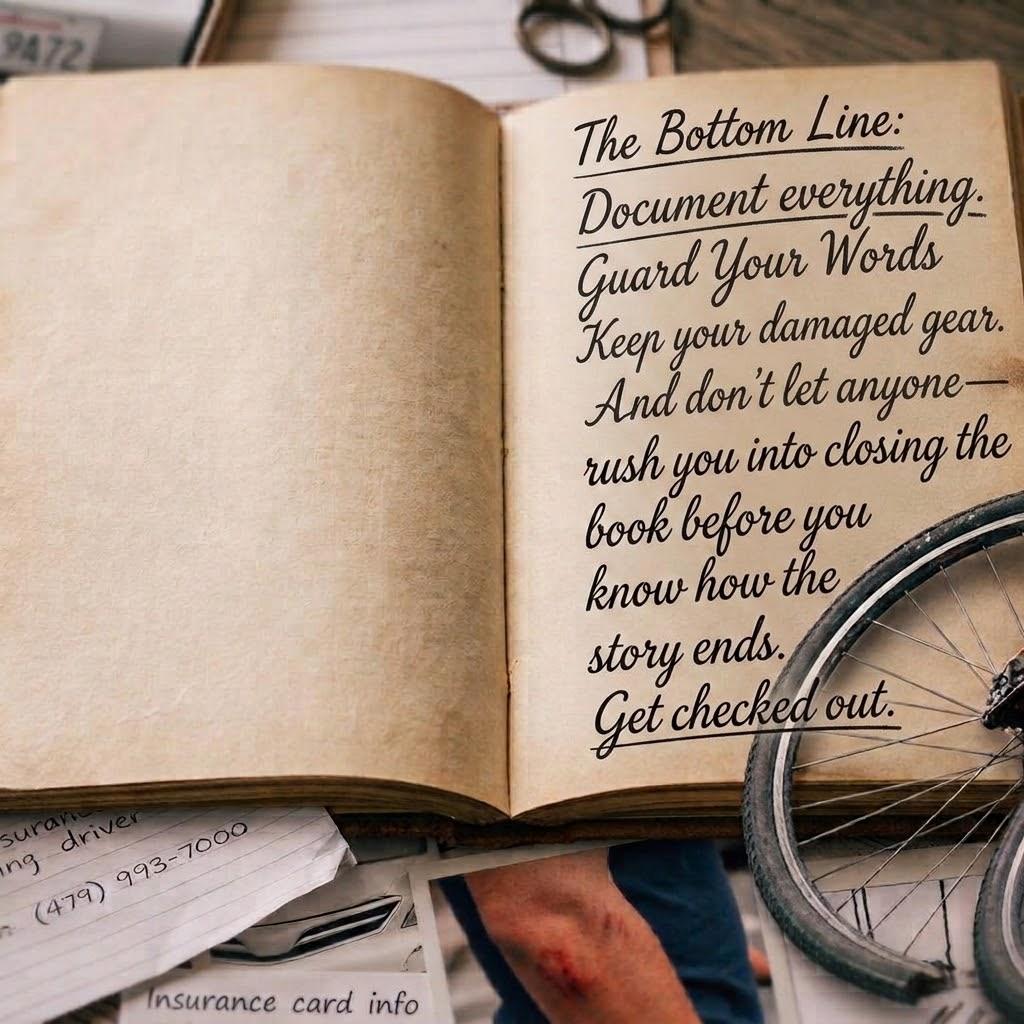
Get checked out. Document everything. Guard your words. Keep your damaged gear. And don’t let anyone—driver or insurer—rush you into closing the book before you know how the story ends.
If you’d like a straight answer about your situation, Kass & Moses, PC offers free, no-obligation consultations at 844-Bicycle or 847-513-9582. Bring your questions; we’ll bring honest answers.
This article is for general information only and is not legal advice. Laws and deadlines vary by state. For guidance on your specific situation, consult a licensed attorney in your area.
Kass & Moses Personal Injury Lawyers
601 Skokie Blvd Suite 401
Northbrook, IL 60062
(847) 513-9582