

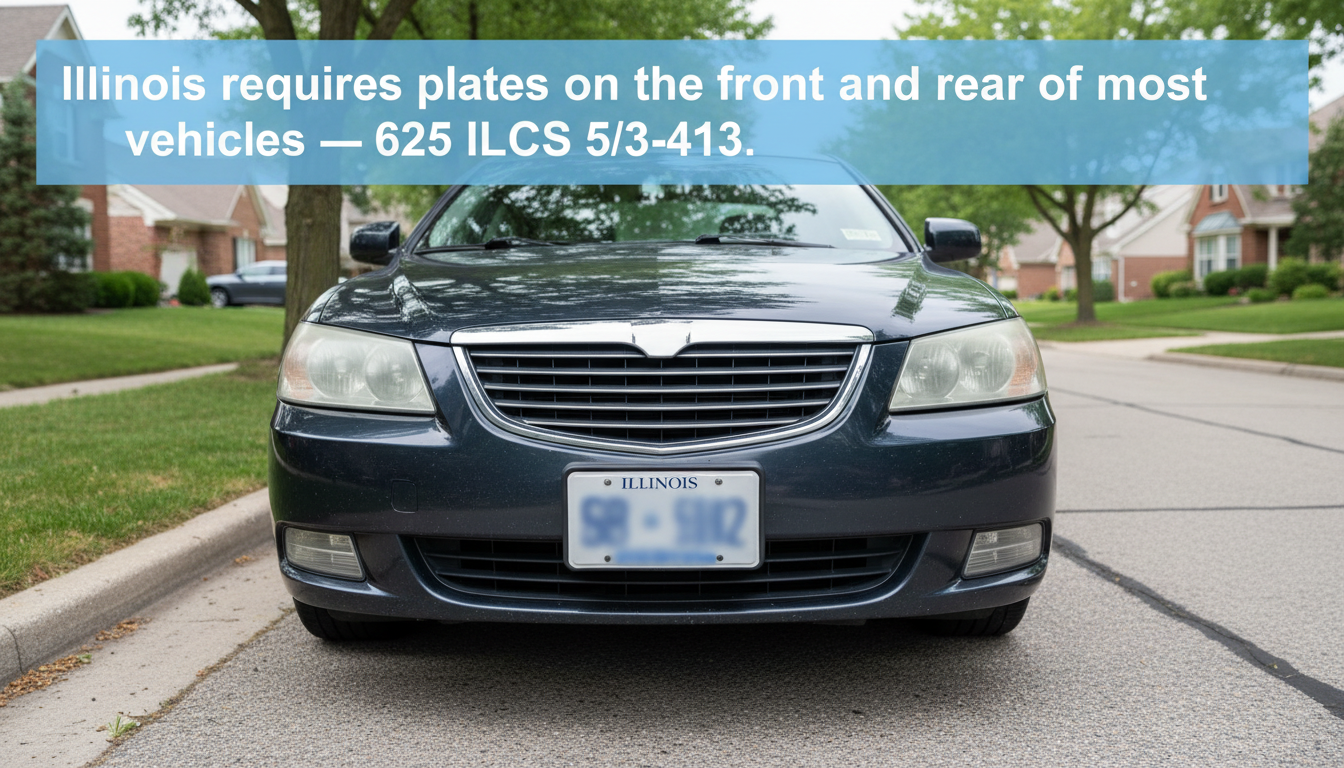
Yes. Illinois requires a plate on the front and the rear of most registered vehicles. It is one of a shrinking number of states that still does, and drivers who move here from a one-plate state are often surprised when a Skokie Boulevard parking lot turns into a ticket.
Here is what the law actually says, who is exempt, what the ticket generally costs, and why a missing front plate can matter after a hit-and-run crash.
Does Illinois require a front license plate?
It does. The requirement comes from the Illinois Vehicle Code, 625 ILCS 5/3-413. For passenger cars, SUVs, and pickups, the Secretary of State issues two plates, and the statute says one goes on the front of the vehicle and one on the rear.
The reason is identification. A front plate gives a witness, a business camera, or a police officer a second chance to read a vehicle that leaves the scene. It also matters for the cameras people drive past every day without thinking: red-light cameras at Chicago intersections, speed cameras in city safety zones, and the Illinois Tollway’s pay-by-plate systems on the Tri-State and the Edens Spur. When a rear plate is dirty, obscured by a trailer hitch, or washed out by headlights on a January night, the front plate is sometimes the only readable one.
What 625 ILCS 5/3-413 requires beyond “two plates”
The statute is not only about how many plates. It generally requires that plates be:
- Securely fastened so they do not swing or hang loose.
- Mounted at a required height above the ground, measured from the bottom of the plate.
- Clearly visible and legible, free of dirt, foreign materials, or anything that blocks the numbers, letters, or the registration sticker.
That last point is where a lot of drivers get caught. A tinted or smoked plate cover, a dealership frame that rides over the top edge, or a bike rack parked across the rear plate can all draw a stop even when both plates are physically on the car. Illinois law treats covers that make a plate harder to read — including harder for a camera to read — as a problem, not a style choice.
Which vehicles only need one plate
Not every vehicle in Illinois gets two plates:
- Motorcycles and motor-driven cycles are issued a single plate, displayed on the rear. Riders who are curious about the rest of the rules can read our plain-language roundup of 10 motorcycle laws in Illinois.
- Trailers and semitrailers likewise carry one plate on the rear.
- Vehicles registered in another state follow their home state’s rules. A car titled in Michigan or Pennsylvania with only a rear plate is not violating Illinois law while it is visiting.
- Temporary registration permits (the paper plates a dealer issues before metal plates arrive) are displayed the way the permit itself directs, usually in the rear window or plate position.
One exception people assume exists but does not: there is no general exemption for cars that came from the factory without a front bracket. Certain electric vehicles, sports cars, and imports ship without a front mount, and some dealers leave the bracket in the trunk rather than drill the bumper. The registration requirement does not change. Owners either install the bracket, use a no-drill mounting kit that tucks into the tow hook or license-plate slot, or risk the ticket.
New to Illinois? The 30-day clock
People who move to Illinois are generally expected to title and register their vehicle here within 30 days of becoming a resident. That is when the second plate shows up, and it is the moment a lot of new North Shore and Chicago residents learn Illinois is a two-plate state. Registration and titling rules are handled by the Secretary of State, and the specifics change from time to time, so the current forms and fees are worth checking directly with that office.
Is it illegal to not have a front license plate in Illinois?
Yes, and it is enforceable on its own. A driver can be stopped and ticketed for a missing or improperly displayed front plate even when nothing else is wrong. Parking enforcement can also write it up while the car sits at a meter or in a public lot — no moving violation required.
A plate-display violation is generally a petty offense, meaning a fine rather than jail. The amount depends on where the ticket is written and on current state and local schedules; the Secretary of State’s office has publicized a figure of up to $164, which is more than most drivers pay to register the vehicle properly in the first place. Fine amounts change, so the current number should be confirmed with the court or the agency that issued the ticket.
Other registration rules that come with the plates
- Do not obstruct either plate. Decorative covers, frames, and trailer accessories cannot block any part of the plate, including the annual registration sticker in the corner.
- Renew on time. Passenger registration in Illinois renews annually, and the renewal notice goes to the address on file — which is why an out-of-date address is a common reason people miss it.
- Put the sticker where it belongs. After renewal, the new sticker goes on the plate in the designated corner, over the old one.
None of this is glamorous. It is, however, the difference between driving past a squad car on Lake Cook Road and explaining yourself on the shoulder.
Why a front plate matters after a crash
This is the part that brings people to a personal injury firm. In a hit-and-run, the case often turns entirely on identification. A front plate is one more surface a witness can read as the other car comes toward them, and one more thing a doorbell camera or a gas-station camera can capture.
When the vehicle is never identified, Illinois drivers are generally left with their own uninsured-motorist coverage, which is required on Illinois auto policies and can apply to hit-and-run claims when the conditions in the policy are met. We walk through how that works in our page on uninsured motorist claims, and cyclists have their own version of the problem, covered in Bicycle Hit-and-Run: Coverage Cyclists Don’t Know They Have.
The reverse question comes up too: can an insurance company blame an injured driver for not having a front plate? Illinois uses modified comparative fault, 735 ILCS 5/2-1116, which reduces a recovery by a person’s share of the fault and bars recovery entirely if that share is more than 50 percent. But fault has to be connected to how the crash happened. A missing front plate does not cause a rear-end collision on the Edens or a left-turn crash in Glenview. An adjuster raising it is usually looking for leverage, not causation.
What drivers must exchange at the scene
Illinois law requires drivers involved in a crash that causes injury, death, or property damage to stop at the scene and give information. Under 625 ILCS 5/11-403, a driver generally must provide:
- Name and address
- The registration number of the vehicle being driven
- The name of the vehicle’s owner
If asked, the driver must show a driver’s license to the other driver, an occupant, or the person struck, and must render reasonable aid to anyone injured, including arranging transport for medical treatment when it is needed or requested.
Illinois also requires a written crash report in certain situations, including when property damage exceeds a set dollar threshold and police did not investigate at the scene. Thresholds and forms change, and the police report number is what an insurer will ask for first, so it is worth confirming the current rule. We cover the mechanics in FAQs: Car Accident Reports in Illinois.
Do you need a lawyer for a front-plate ticket?
Generally, no. A plate-display ticket is a petty offense handled in traffic court, often at a suburban courthouse or one of the Cook County branch courts, and plenty of people resolve it by installing the plate and paying the fine. It is not a personal injury matter, and a personal injury firm is not the right call for it.
Where a lawyer becomes relevant is when someone is hurt — a driver whose vehicle left the scene, a cyclist doored on a city street, a pedestrian hit in a crosswalk. Those cases involve medical records, an insurer’s first phone call, and a demand, and that is a different conversation than a $164 ticket. If a plate question is really a crash question underneath, the car accident and bicycle accident pages explain what usually happens next.
This article is general information about Illinois law, not legal advice about any particular situation. Every case is different, and deadlines and penalties have exceptions, so a lawyer should be consulted about a specific set of facts.
Contact Our Northbrook Car Accident Law Firm at Kass & Moses Personal Injury Lawyers
If you were injured in a crash in Northbrook or elsewhere in the Chicago area and want to talk through your options, you can contact the Northbrook personal injury lawyers at Kass & Moses Personal Injury Lawyers to schedule a free case review.
Kass & Moses Personal Injury Lawyers 601 Skokie Blvd Suite 401 Northbrook, IL 60062 (847) 513-9582
Frequently asked questions
Yes. For vehicles issued two plates, displaying only the rear plate is generally a violation of the Illinois Vehicle Code, 625 ILCS 5/3-413, and it can be ticketed on its own — including while the car is parked. It is typically a petty offense punished by a fine rather than jail.
The requirement does not change because the bumper has no mount. Some electric vehicles, sports cars, and imports ship without a front bracket, and some dealers leave it uninstalled. Owners generally either install the bracket or use a no-drill mounting kit that attaches at the tow hook or plate slot.
No. A vehicle registered in another state follows that state’s plate rules while it is in Illinois. People who move here, though, are generally expected to title and register the vehicle in Illinois within 30 days, and that is when the second plate applies.
No. Motorcycles and motor-driven cycles are issued a single plate that is displayed on the rear. Trailers and semitrailers also get one rear plate.
Adjusters sometimes raise it, but fault in Illinois has to connect to how the crash happened. Under modified comparative fault, 735 ILCS 5/2-1116, a recovery is reduced by a person’s share of the fault and barred if that share is more than 50 percent — and a missing front plate does not cause a rear-end or left-turn collision. Every case is different, so a lawyer should look at the specific facts.