
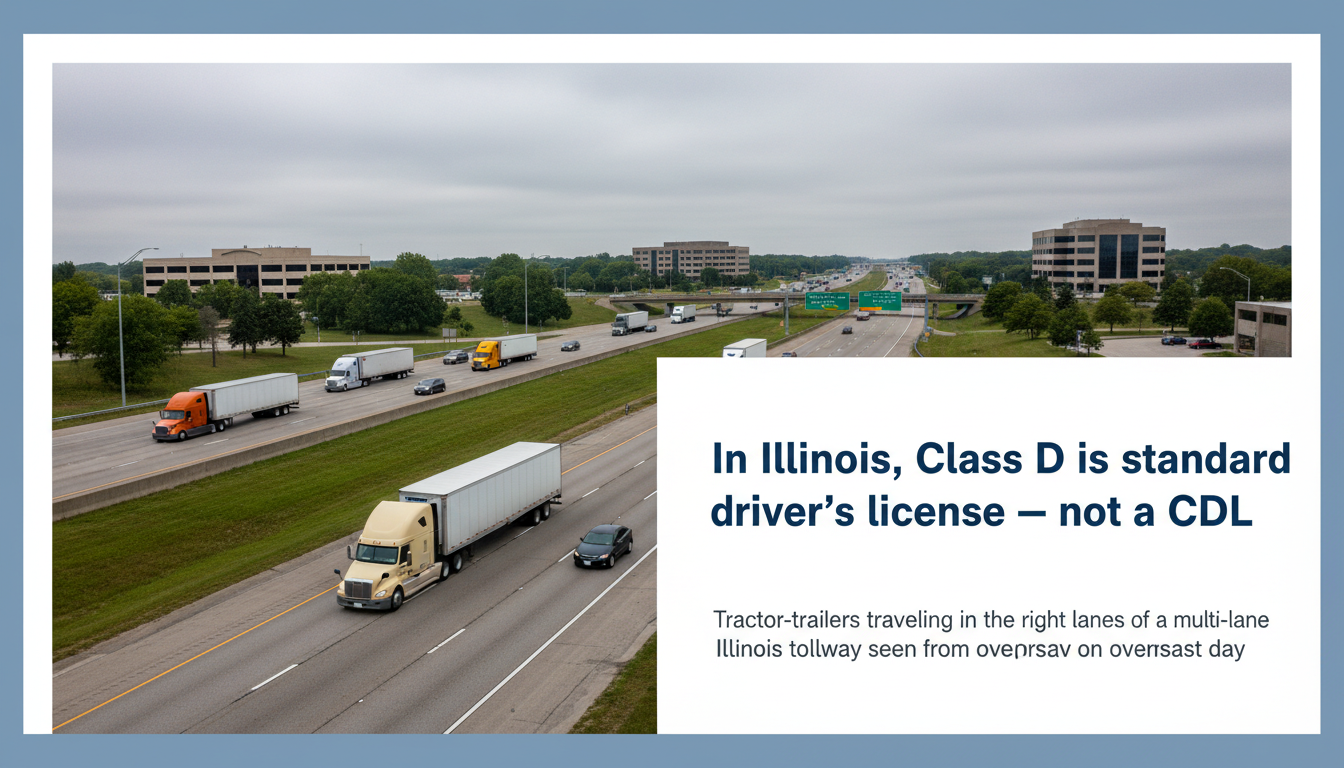
Illinois issues three classes of commercial driver’s license: Class A, Class B, and Class C. Which one a driver needs comes down to two things — how much the vehicle weighs and what it carries — not the job title on a paycheck. A person hauling gravel on the Tri-State, a school bus driver in Glenview, and a fuel truck driver on Lake Cook Road may each hold a different class.
There is one more thing worth clearing up right away: in Illinois, a Class D license is not a CDL. It is the ordinary license most drivers carry. More on that below.
What counts as a commercial license
A Commercial Driver’s License is a license to operate a commercial motor vehicle, and both federal rules and Illinois law set the standards for it. Illinois’ commercial licensing rules sit in the Illinois Vehicle Code at 625 ILCS 5/6-500 and the sections that follow, which track the federal classification rules in 49 CFR Part 383. That is why a Class A CDL means the same thing in Indiana and Wisconsin as it does here.
Three numbers do most of the work:
- GVWR — gross vehicle weight rating, the maximum loaded weight of a single vehicle set by the manufacturer.
- GCWR — gross combination weight rating, the same idea for a truck plus what it is towing.
- 26,001 pounds — the line where CDL territory generally begins.
Class A CDL
A Class A CDL is the most comprehensive license. It allows drivers to operate a combination of vehicles with a gross combination weight rating (GCWR) of 26,001 pounds or more, provided the towed vehicle is heavier than 10,000 pounds.
Examples of vehicles requiring a Class A CDL include:
- Tractor-trailers
- Livestock carriers
- Tanker trucks
- Flatbeds
A Class A holder can generally also operate Class B and Class C vehicles, as long as they hold any endorsement that type of vehicle requires. That is the practical reason “class a commercial drivers license” is the one most freight employers ask for. Drivers may also need endorsements depending on the cargo, such as hazardous materials.
Class B CDL
A Class B CDL covers single vehicles with a GVWR of 26,001 pounds or more, or such a vehicle towing a trailer that does not exceed 10,000 pounds. This license is often used by drivers who operate large vehicles for construction, transit, or delivery purposes.
Examples of vehicles requiring a Class B CDL include:
- City buses and school buses
- Dump trucks
- Straight trucks
- Delivery trucks with smaller trailers
A Class B license is somewhat more limited than a Class A. It still requires specialized training and testing, particularly when passengers are involved. A CTA bus driver and a Pace driver are generally Class B holders with a passenger endorsement.
Class C CDL
A Class C CDL is required for vehicles that do not meet Class A or Class B definitions but are designed to transport 16 or more passengers (including the driver), or are used to transport hazardous materials in amounts that require placards.
Examples of vehicles requiring a Class C CDL include:
- Small passenger vans used for shuttles
- Certain hazmat vehicles, such as smaller tankers or trucks carrying regulated amounts of chemicals
- Vehicles designed for group transportation, such as church buses or airport shuttles
This is the class that surprises people. A van that weighs far less than a dump truck still needs a CDL once it is built for 16 or more riders or placarded for hazardous cargo. The risk, not the tonnage, drives the requirement.
Class D is not a CDL in Illinois
Searches for a “Class D commercial driver’s license” turn up a lot of confusion, and here is the reason. Illinois uses letters for non-commercial licenses too. Class D is the standard Illinois driver’s license for ordinary cars and light trucks. Class L and Class M cover motorcycles.
Illinois also issues non-CDL Class A, B, and C licenses for heavy vehicles that are not being used commercially — a large motorhome or a big recreational trailer, for example. Someone towing a heavy fifth-wheel to Wisconsin for the weekend may need an upgraded non-commercial classification without needing a CDL at all. The Secretary of State’s Driver Services facilities handle both tracks, which is part of why the letters get mixed up.
CDL endorsements in Illinois
Drivers may need endorsements that permit them to operate specialized vehicles or carry specific cargo. They are required in addition to obtaining the correct class of CDL. These endorsements require additional knowledge tests and, in some cases, skills tests.
Common endorsements include:
- H – Hazardous Materials (HazMat)
- N – Tank Vehicles
- P – Passenger Transport
- C – Charter Bus
- S – School Bus
- T – Double and Triple Trailers
- X – Tank Vehicle and Hazardous Materials combined
Licenses can also carry restrictions that work in the opposite direction. A driver who tests in a truck with an automatic transmission generally gets a restriction barring manual transmissions, and a driver who tests in a vehicle without air brakes generally cannot operate one that has them.
Failing to obtain the correct endorsements can lead to license suspension, fines, or even criminal charges if negligence causes a truck accident.
Illinois CDL requirements, step by step
Getting a CDL in Illinois is a step-by-step process designed to make sure drivers have the knowledge, skills, and qualifications to operate large commercial vehicles safely.
- Meet the basic requirements: Applicants must generally be at least 18 years old for intrastate driving, and at least 21 for interstate driving, transporting hazardous materials, or carrying passengers. They must also hold a valid Illinois driver’s license.
- Complete entry-level driver training: Under federal rules that took effect in February 2022, first-time Class A and Class B applicants, drivers upgrading from Class B to Class A, and first-time applicants for the H, P, or S endorsements generally must finish training with a provider listed on the federal Training Provider Registry before taking the skills test.
- Get a Commercial Learner’s Permit (CLP): Applicants provide proof of identity and residency, pass the written knowledge tests, and submit a current medical examiner’s certificate where one is required.
- Hold the CLP for 14 days: The CLP must generally be held for at least 14 days before the skills test, so the driver can practice under supervision.
- Pass the CDL skills test: The skills test covers the pre-trip inspection, basic vehicle control, and on-road driving.
- Add endorsements: HazMat also requires a federal background check and fingerprinting.
The Illinois Secretary of State issues the CDL once these steps are complete and fees are paid. Holding the license is an ongoing obligation, not a one-time hurdle: the medical certificate has to stay current, and a driver who shows up in the federal Drug and Alcohol Clearinghouse in prohibited status can have the commercial privilege downgraded.
Why the license class matters after a truck or bus crash
For someone hurt in a collision with a commercial vehicle on the Edens, the Kennedy, or a two-lane road in Lake County, the driver’s class and endorsements are more than paperwork. They point to a set of records that a passenger-car crash simply does not generate.
- Whether the driver was qualified for that vehicle. A driver with a Class B license behind the wheel of a tractor-trailer, or a driver hauling placarded chemicals without an H endorsement, raises questions about the employer’s hiring and supervision as well as the driver’s conduct.
- Which rulebook applies. A truck crossing the state line runs under federal hours-of-service and inspection rules. A dump truck working only between Waukegan and Northbrook may not. The difference is explained in more detail in interstate versus intrastate trucking.
- Alcohol limits are lower. A commercial driver is generally held to a 0.04 blood alcohol level while operating a commercial vehicle, half the 0.08 that applies to other drivers.
- Post-crash testing and logs. Federal rules require drug and alcohol testing after certain crashes, and carriers keep driver qualification files, inspection reports, and electronic logging device data. Those records have retention periods, which is one reason lawyers send preservation letters early. Driver fatigue records often matter most in the crashes that happen in the small hours.
- Insurance is usually larger. Interstate carriers hauling general freight generally must carry federal minimum liability coverage well above what a private car policy provides, with higher minimums for hazardous cargo.
Deadlines differ too. In Illinois, the general deadline to file an injury lawsuit is two years, 735 ILCS 5/13-202. If the vehicle belongs to a city, a village, or another local public entity, the deadline is generally one year under 745 ILCS 10/8-101. For injuries on a CTA bus or train, written notice generally must reach the CTA within six months and suit must be filed within one year, 70 ILCS 3605/41. Exceptions exist and the facts change the analysis, so anyone with a claim should confirm the date that applies to their situation with a lawyer.
When a crash with a commercial vehicle usually does not need a lawyer
Not every one of these calls needs an attorney. A low-speed tap from a delivery van in a parking lot off Skokie Boulevard, with no injury and a repair estimate the carrier’s insurer pays without argument, is usually a property damage claim a person can handle alone. The picture changes when someone is treated for an injury, when fault is disputed, or when the vehicle was operating under federal rules and the records start to matter.
Talk with the Lake County truck accident lawyers at Kass & Moses
People hurt in a crash with a truck or bus in Chicago or the suburbs can call Kass & Moses Personal Injury Lawyers for a free consultation. Our office is in Northbrook, and we handle cases throughout Cook, Lake, and DuPage County. Every case is different, and nothing here is advice about any particular claim.
We serve throughout all of Northbrook, IL, and Lake County.
**Kass & Moses Personal Injury Lawyers **601 Skokie Blvd Suite 401 Northbrook, IL 60062 (847) 513-9582
Frequently asked questions
Class A covers combinations of vehicles with a gross combination weight rating of 26,001 pounds or more when the towed unit is over 10,000 pounds — a tractor pulling a trailer, for example. Class B covers a single heavy vehicle of 26,001 pounds or more, such as a dump truck or a city bus, towing nothing heavier than 10,000 pounds. A Class A holder can generally operate Class B and Class C vehicles as well, if they have any endorsement those vehicles require.
There is no single answer, but the timeline has fixed pieces. A Commercial Learner’s Permit generally must be held for at least 14 days before the skills test, and first-time Class A and Class B applicants generally must finish entry-level driver training through a provider on the federal Training Provider Registry first. Training program length, testing appointment availability, and background checks for a HazMat endorsement all affect the total.
Usually not. Illinois issues non-commercial Class A, B, and C licenses for heavy vehicles that are not used commercially, such as large motorhomes and heavy recreational trailers. Those are upgrades to a regular license rather than CDLs. The Illinois Secretary of State’s Driver Services facilities can confirm which classification a particular vehicle and trailer combination requires.
It depends on the crash and what the investigation shows. Federal rules require drug and alcohol testing after certain crashes involving commercial vehicles, and a commercial driver is generally held to a 0.04 blood alcohol level while operating one, half the limit for other drivers. Serious violations can lead to disqualification of the commercial privilege even when the regular driving privilege stays intact.
Not by itself, but it points to records. The class and endorsements show what the driver was qualified to operate, and commercial carriers generally keep driver qualification files, inspection reports, and electronic logging device data that a passenger-car crash never produces. Those records have retention periods, which is why preservation requests usually go out early in these cases.