




Illinois does not give a dog one free bite. Under the Animal Control Act, 510 ILCS 5/16, a dog owner can be responsible the first time their dog bites or attacks someone, even if the dog had never shown a hint of aggression before. That single sentence is the most useful thing to know about a dog bite in Illinois, and it is the part most people get wrong.
Kass & Moses, P.C. handles dog bite claims from our office at 601 Skokie Blvd., Suite 401 in Northbrook. You can reach us at 847-513-9582 or through our contact form for a free consultation. What follows is general information about how these claims work in Illinois, not advice about any one situation.
What the Animal Control Act Requires a Person to Show
Most injury cases turn on proving someone was careless. A dog bite case in Illinois usually does not. Under 510 ILCS 5/16, an injured person generally has to show four things:
- The dog attacked, attempted to attack, or otherwise injured the person
- The person was in a place they had a legal right to be, including public property and private property they were invited onto
- The person was conducting themselves peaceably, meaning they did not provoke the dog
- The attack caused injury
Notice what is missing. There is no requirement to prove the owner was careless with the leash, the gate, or the fence. There is no requirement to show the dog had bitten before. An owner who did everything right can still be responsible under the statute.
One detail people miss: the statute is not limited to teeth. A dog that knocks a cyclist off a bike on the Techny Trail or jumps on a delivery driver and breaks a wrist can fall under the same law, because the statute covers an attack or other injury caused by the animal.
Who Actually Pays a Dog Bite Claim
These claims are almost never paid out of an owner’s pocket. They are usually paid by a homeowner’s or renter’s insurance policy, and the liability part of those policies typically covers dog bites anywhere the owner is responsible, not only bites that happen at the house.
A few things that matter in practice:
- Renters have coverage too. A renter’s policy carries liability coverage that often works the same way for a dog bite as a homeowner’s policy does.
- Policy limits cap the claim. Home and renter’s policies carry a liability limit, commonly in the range of a few hundred thousand dollars. Some owners also carry an umbrella policy that sits on top of it.
- Some policies exclude certain dogs. Insurers sometimes exclude specific breeds or a dog with a prior bite on record. When that happens, the claim may have to look elsewhere, including at a landlord or property manager who knew a dangerous dog was on the premises.
- If there is no policy at all, the claim is against the owner personally, which is a very different and often much harder road.
Report the Bite, and Get the Report Number
In Northbrook, animal complaints and bite reports generally go through the Northbrook Police Department, and dog bites in Cook County are reported to the Cook County Department of Animal and Rabies Control. Elsewhere, the report usually goes to the local police department plus the county animal control or health department: Lake County bites through the county’s animal care and control program, Kane County bites through Kane County Animal Control. Illinois law also calls for a dog that has bitten to be confined and observed for ten days so it can be checked for rabies.
That report does more than protect public health. It creates a dated, third-party record of the dog, the owner, the address, and the vaccination history. Insurers take that record seriously. Bites that are never reported often come down to one person’s word against another’s months later, after the owner has had time to describe the event differently.
County animal control administrators also have a separate process under the Animal Control Act for declaring a dog dangerous or vicious, which can require muzzling, a locked enclosure, or in the worst cases euthanasia. That is a public-safety proceeding. It runs on its own track, and it does not pay anyone’s medical bills.
Other things that help, and are easiest to do in the first day or two: photograph the wounds before they are cleaned and again as they heal, photograph the yard, gate, or leash, write down the names of anyone who saw it, and keep the discharge paperwork from the urgent care or emergency room.
What Usually Happens After a Dog Bite Claim Is Opened
The order is fairly predictable, even though the timing is not.
- Medical care, usually the same day. Bite wounds are dirty wounds, and hand and face bites get infected more often than people expect. The chart from that first visit is also the document that ties the injury to the dog.
- The bite report. Filed with the police or animal control, with a report number written down.
- The owner’s insurer opens a claim. An adjuster often calls within a few days and asks for a recorded statement and a signed authorization for medical records. Nothing requires giving a recorded statement, and people often wait until they have talked with a lawyer before deciding. An early offer that arrives before treatment is finished is usually based on the bills that exist so far, not on the scar that is still forming.
- Treatment finishes, or reaches a stable point. Nobody can price a scar that is still changing. This is the step that sets the pace of everything after it.
- Records and bills are gathered. Hospitals and billing companies commonly take several weeks to send complete records, and health insurers and public programs often assert a lien, meaning a right to be repaid out of any settlement.
- A demand is sent, then negotiation. A written demand with the records attached typically draws a response in a matter of weeks, followed by back-and-forth.
- If there is no agreement, a suit is filed before the deadline runs. A filed case in Cook or Lake County generally takes a year or more to reach a trial date, and most cases resolve before one.
How Common Are Dog Bites?

The Insurance Information Institute has reported that roughly 4.5 million Americans are bitten by dogs each year. Illinois regularly lands among the states with the most dog bite liability claims, with an average claim cost above the national figure. Those counts are updated every year, so the current numbers will differ from any figure published earlier.
When a Dog Bite Usually Does Not Need a Lawyer
Plenty of dog bites do not turn into legal cases, and we would rather say so than pretend otherwise. A nip from a neighbor’s dog that breaks the skin, gets cleaned at an urgent care, needs no stitches, and leaves no scar is often handled directly: the owner reports it to their insurer, the medical bill is paid under the policy’s medical payments coverage, and that is the end of it.
The situations that tend to need a lawyer look different. Wounds that required stitches or surgery. Bites to the face, hands, or scalp. Anything likely to leave a visible scar. Bites to young children. An owner who denies the dog was theirs, says the dog was provoked, or has no insurance. A bite that got infected. In those cases, the value of the claim is mostly in the future, and the early number an insurer puts on the table rarely accounts for it.
How Much Is a Dog Bite Claim Worth?

There is no formula, and no reliable way to put a number on a claim before the medical picture is clear. Every case is different and results vary. What generally drives the value:
- The nature and permanence of the injuries, especially scarring
- The cost of medical care and other out-of-pocket expenses
- Income lost during recovery
- How the attack affected the person’s mental health
- Physical pain
- Expected future effects, including further surgery or lasting trauma
Children are bitten more often than adults, and bites to a child’s face are more common because of height. Scar revision surgery for a child is sometimes delayed for years until growth is finished, which is one reason these claims are rarely settled early. We handle those through our Northbrook child injury practice.
What Types of Damages Are Available to Dog Bite Victims?
Damages in Illinois injury cases are grouped as economic damages or non-economic damages. Common categories include:
- Current medical bills
- Reasonably expected future medical costs, including scar revision
- Rehabilitation
- Lost income and lost future earning capacity
- Mental health treatment
- In-home assistance
- Pain and suffering
- Emotional distress and PTSD
- Disfigurement and scarring
- Loss of a normal life
Who Is Responsible for Paying Damages After a Dog Bite?

Usually the owner. But the Animal Control Act reaches beyond the owner to a person who was keeping or in control of the dog at the time, which can bring in:
- Dog walkers and pet sitters
- Groomers, kennels, and doggie daycares
- Property owners and managers
- The employer of whoever had the dog
Finding every responsible party matters because each may bring a separate insurance policy with it.
Where Negligence Still Comes In
A claim against someone other than the owner or keeper often has to be proved the ordinary way. To hold a property owner or manager responsible, the case generally has to show that they controlled the property, that they knew or should have known a dangerous dog was there, and that they failed to do anything about it. A loose dog repeatedly reported in an apartment complex courtyard is the classic example, and it is a premises liability case as much as a dog case.
What Does a Dog Bite Lawyer Cost?

Kass & Moses, like most injury firms, works on a contingency fee. The fee is a percentage of any recovery, commonly around one third, and there is no fee if there is no recovery. Case costs, such as records fees and filing fees, are handled separately, and the written agreement spells out exactly how. There is no charge to have a case looked at.
Provocation and Comparative Fault
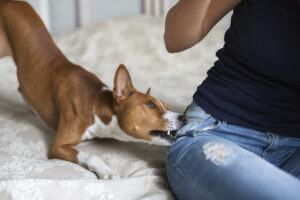
Provocation is the defense insurers raise most often, because it is written right into 510 ILCS 5/16. Illinois courts have looked at whether the dog’s reaction was out of proportion to what the person did, and an unintentional act, like a small child tripping over a sleeping dog, is not automatically provocation.
Illinois also follows modified comparative fault, 735 ILCS 5/2-1116. Damages are reduced by a person’s own share of fault, and a person who is more than 50% at fault recovers nothing. Expect an adjuster to probe for it in the first phone call.
Dog Bite Injuries These Claims Involve
Puncture wounds and torn skin, disfigurement and scarring, nerve damage, broken bones, traumatic brain injuries from a fall during the attack, crushing injuries, infection, and in rare cases sepsis. Infection is the risk that turns a moderate bite into a catastrophic one, especially with hand wounds and unvaccinated dogs. Fatal attacks are rare, and when one happens the claim becomes a wrongful death case with its own rules.
How Long Is the Deadline in Illinois?
Generally, two years from the date of the bite, under 735 ILCS 5/13-202. Exceptions exist, and they matter:
- Children. A parent can bring a claim on a child’s behalf right away. Illinois also generally gives a minor until two years after turning 18 to sue on their own, under 735 ILCS 5/13-211.
- Bites involving a city, village, park district, or other local public entity. The deadline is generally one year, under 745 ILCS 10/8-101, which is half the usual time and catches people off guard. A bite by a police dog, or a bite on park district property, can fall here.
Deadlines, including these outer limits, have exceptions that depend on the facts. Anyone with a possible claim should confirm their own date with a lawyer rather than counting on a general rule.
Where a Dog Bite Case Gets Filed in Illinois
The Animal Control Act is a state law. It applies the same way in Elgin, Mundelein, Belvidere, Skokie, Glenview, and everywhere else in Illinois. What changes from town to town is which agency takes the bite report and which courthouse the case is filed in, since a suit is generally filed in the county where the bite happened or where the defendant lives.
- A Northbrook or Chicago bite is a Cook County case, filed at the Daley Center downtown or in one of the suburban municipal districts, including the Second District courthouse in Skokie.
- A Mundelein or Libertyville bite is a Lake County case, filed at the courthouse in Waukegan.
- An Elgin bite is usually a Kane County case, filed at the Kane County Judicial Center in St. Charles. Part of Elgin sits in Cook County, and that line decides the courthouse.
- A Belvidere bite is a Boone County case, filed in Belvidere.
Our office is in Northbrook and we handle claims across Chicago, the North Shore, and Cook, Lake, and DuPage County. If the bite happened in Lake County, start with our Lake County dog bite lawyer page. Our areas we serve page lists the communities we cover. For a bite well outside that area, calling is still worth the few minutes; if it is not a case we are the right fit for, we can point people toward a firm closer to the county where it would be filed.
Talk to a Northbrook Dog Bite Lawyer

Questions about a dog bite and who is responsible for it are worth asking out loud before the claim gets far. Kass & Moses, P.C., 601 Skokie Blvd., Suite 401, Northbrook, IL. Call 847-513-9582 or use our contact form to set up a free consultation.
Frequently asked questions
This is the most common reason people hesitate. A dog bite claim is almost always paid by the owner’s homeowner’s or renter’s liability insurance, which is exactly what that coverage exists for. The owner is not writing a personal check, and in most cases their involvement is limited to reporting the bite and answering their insurer’s questions. Premiums can go up, and that is worth knowing, but the claim itself is generally an insurance matter.
Usually the renter’s own liability policy, if they carry one. A landlord or management company can also be responsible in some situations, but that is a negligence claim, not a claim under 510 ILCS 5/16: it generally has to show the landlord knew or should have known a dangerous dog was on the property and did nothing. Prior complaints to the building office are often what make or break that part of a case.
The Animal Control Act applies statewide, so the law is identical in every one of those towns. Our office is in Northbrook and we handle claims across Chicago, the North Shore, and Cook, Lake, and DuPage County, which covers Mundelein and the part of Elgin that sits in Cook County. A Kane County or Boone County bite is filed further out, and it is still worth calling; if it is not a case we are the right fit for, we can point people toward a firm nearer the courthouse where it would be filed.
Possibly. 510 ILCS 5/16 covers an attack, an attempted attack, or other injury caused by the animal, so a dog that lunges at a jogger or a cyclist and causes a fall can fall under the same statute even with no puncture wound. Broken wrists and head injuries from those falls are often more serious than the bite wounds people picture.
The claim is then against the person, and collecting it is a practical problem rather than a legal one. Cases like that often turn on whether anyone else was in control of the dog, whether a landlord or business shares responsibility, or whether the injured person’s own homeowner’s or health coverage helps with the bills. It is one of the first things worth checking before spending months on a claim.
It depends mostly on the medical picture, because a claim is not usually valued until treatment has finished or reached a stable point. After that, gathering complete records and bills often takes several weeks, a written demand typically draws a response in a matter of weeks more, and negotiation follows. Claims that cannot be settled turn into a lawsuit filed before the deadline, and a filed case in Cook or Lake County generally takes a year or more to reach a trial date. Every case moves differently.